


When you finish running the MRP calculation in the requisition worksheet in Business Central, you still have a few steps left before you have actual purchase orders. This article walks through how the action messages work, how Business Central bundles lines onto purchase orders, and why many purchasers choose to plan one vendor at a time.
The key takeaway is that the checkmarks in the requisition worksheet control exactly what gets carried out. If a line is not checked, nothing happens to it. Lines for the same vendor get bundled onto a single purchase order, so you need to review the suggestions and adjust the checkmarks before you carry out.
Carrying out lines from the requisition worksheet in Business Central
Once the MRP planning calculation is done, you as a purchaser have to run through all the lines in the requisition worksheet and carry them out to create purchase orders. The mechanics are easy: you choose Process, then Carry Out, then Create Purchase Orders.
Each line carries an action message. A “New” action message means Business Central will create a new purchase order when you carry out that line. You will also see other action messages, such as change quantity or reschedule, and you need to take those into account before carrying out.
How Business Central bundles lines onto purchase orders by vendor
When you place the checkmarks on the action messages and carry out, Business Central bundles all the items for the same vendor onto the same purchase order. If two lines share the same vendor number, they end up together on one purchase order.
You can control this. If you carry out only some of the checked lines, for example the line for the rim, you get a purchase order for the rim. Afterwards you can carry out another line, for the spokes, and get a separate purchase order. So you need to be aware of how the bundling works and decide how you want the lines grouped before carrying out.
Why purchasers often plan per vendor
In a real setup you typically have many lines, and you have to manually set and remove the checkmarks for the action messages you want to handle. For this reason, many purchasers prefer to plan per vendor. Working one vendor at a time keeps the number of lines in the worksheet down and makes it easier to manage which checkmarks are set.
How the checkmarks control what gets handled
The checkmarks decide what gets handled when you carry out. If you check nothing and choose Carry Out, nothing happens. The checkmarks are there to mark exactly what you want to process.
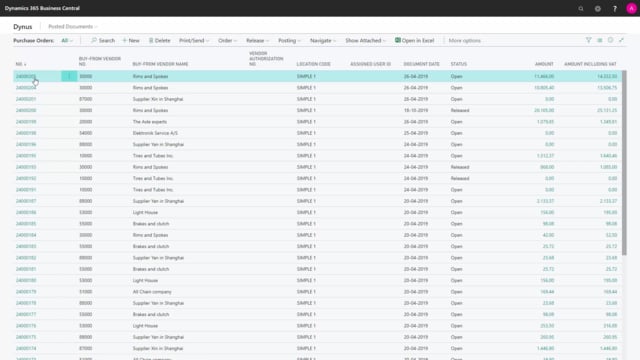
When the Business Central planning engine is satisfied with a suggestion, it sets the checkmark by default. From there you can carry out, confirm with Yes, and Business Central removes the handled lines from the worksheet. If you then open your purchase orders and take the most recent one, you will see the purchase order just created with the quantities from the worksheet.
Q&A
What happens if you carry out a requisition worksheet line with no checkmarks set?
Nothing gets handled. The checkmarks control what is processed, so if no lines are checked, no purchase orders are created.
How does Business Central group lines onto purchase orders?
It bundles all the items for the same vendor onto the same purchase order. Lines that share the same vendor number end up together on one order.
Can you split lines for the same vendor onto separate purchase orders?
Yes. Carry out one line first, such as the rim, to create one purchase order, then carry out another line, such as the spokes, to create a separate purchase order.
Why do many purchasers plan per vendor?
Planning one vendor at a time keeps the number of lines in the requisition worksheet manageable, since you otherwise have to manually set and remove checkmarks across many lines.
Does Business Central set the checkmarks automatically?
Yes. When the planning engine is satisfied with a suggestion, it sets the checkmark by default, so you can review and adjust before carrying out.