


As a planner in Business Central, your item card gives you a range of actions that help you plan replenishment, review availability, and keep an overview of demand and supply. This article walks through the most relevant ones, from creating stock keeping units to checking availability by event, period, variant, location, and bill of material level.
You create stock keeping units from the Functions action on the item card. Use them when you want to plan per location or per item variant. A report auto-creates the units for each location or for locations with inventory.
The Sales Forecast action opens a Microsoft plugin that calculates an intelligent sales forecast based on events in your system. The forecast links to your item sales forecast and gives you a suggestion for your actual forecast.
You open the requisition worksheet directly from the item card. This is the worksheet purchasers and planners normally use to plan and create purchase orders.
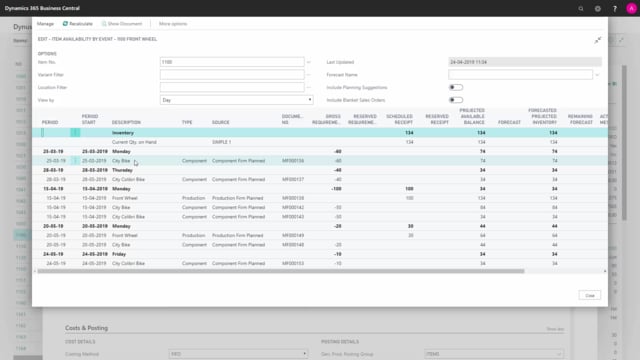
The availability views let you see how inventory develops over time by event, by period, by variant, by location, and by bill of material level. You can drill into each figure to see what it consists of, such as a production component demand, planned order releases, or the projected available balance.
Creating stock keeping units from the item card
On the action tab under Functions, you can create stock keeping units. If you want to plan per location or per item variant, stock keeping units make that possible. The function runs a report that auto-creates the units, for example one per location or per location with inventory. This is simply the way to build the underlying stock keeping units you need for more detailed planning.
Using the sales forecast plugin from Microsoft
Under the Forecast action you find the sales forecast. This is an API, a plugin from Microsoft, that calculates the sales forecast based on the events in your system. The forecast gives you an intelligent suggestion for your actual forecast and relates to your item sales forecast. It is a starting point you can work from rather than a number you have to calculate by hand.
Opening the requisition worksheet from the item
You can open the requisition worksheet directly from the item card for the specific item you are working on. This is the worksheet purchasers and purchase planners normally use to plan and create purchases. Opening it from the item card saves you from navigating around to find it.
Reviewing item availability by event period
On the navigation tab you have availability and availability by event period, both often used by planners to get an overview of item availability. When you look at availability by event, a line is inserted for every event known in the system. That includes all open orders, demands, and supplies on production orders, sales orders, purchase orders, and so on. You can then see how the inventory level develops over time, event by event.
Reviewing item availability by period
Instead of one line per event, you can see availability by period, for example per month, per week, or per day. If you look at March, you see all the events for that month and can drill into the different fields to see what they consist of. A figure might be a production or component demand, and if there are more demands you see them listed. You also see the planned order releases and the projected available balance for the item per period.
Reviewing availability by variant and by location
You can see item availability by variant if you work with item variants. If you plan with different variants, you get a view per variant. The same applies to location: you see all locations on lines, with inventory levels, scheduled receipts, and requirements per location. The variant view works the same way, just with variants listed down the lines instead of locations.
Reviewing availability by bill of material level
You also have availability by bill of material level. When you open it, you see the bill of material hierarchy with your item in the top line and the bill of material extracted below. You see the quantity per unit of measure as defined by the bill of material, the replenishment system, the available quantity, and the quantity you are able to make of the top item and of each specific component. This gives you a quick overview of where you need specific items in order to fulfil your demands.
Viewing availability on a graphical timeline
Availability is also shown by timeline, a graphical view you can display the item in. The timeline gives you a visual way to follow availability over time.
Overview of stock keeping units on the warehouse tab
On the warehouse tab you can get an overview of your stock keeping units. If the item has several stock keeping units, you get a list of them here. This makes it easy to see all the units tied to a single item in one place.
Q&A
How do you create stock keeping units in Business Central?
You create them from the Functions action on the item card. A report auto-creates stock keeping units per location or per location with inventory, so you can plan per location or per item variant.
What does the sales forecast on the item card do?
It is a Microsoft plugin (API) that calculates an intelligent sales forecast based on the events in your system. It gives you a suggestion for your actual forecast and relates to your item sales forecast.
What is the difference between availability by event and availability by period?
Availability by event inserts a line for every event known in the system, such as open orders, demands, and supplies, so you see inventory develop event by event. Availability by period groups those events into intervals like month, week, or day, so you see the projected available balance per period.
Can you check item availability per variant and per location?
Yes. If you work with item variants, you can see availability per variant. You can also see availability per location, with inventory levels, scheduled receipts, and requirements for each location.
What does availability by bill of material level show?
It shows the bill of material hierarchy with your item in the top line, the quantity per unit of measure, the replenishment system, the available quantity, and how many of the top item and each component you can make. It helps you see where you need specific items to fulfil demand.
Where do you see all stock keeping units for an item?
On the warehouse tab on the item card. If the item has several stock keeping units, you get a list of them there.