
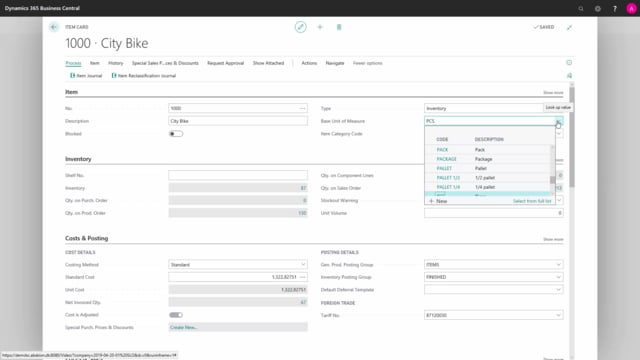


In Microsoft Dynamics 365 Business Central, the base unit of measure on the item card defines how an item is stored in inventory. You set this base unit on each item card, and it also acts as the conversion basis for any alternative units of measure you set up.
You select the base unit of measure from the Unit of Measure list. To add new units, use Add New or Select from Full List on the item card.
You can translate units of measure into other languages. Open the unit, go to Navigate, then Units and Translations, and add a language code with the translated description. For example, a unit can be called “Stk” in Danish and “Pcs” in English.
The base unit of measure on the item card
On the item card you specify which base unit of measure the item is stored in. This is the foundation for how the item is handled in inventory.
The base unit of measure also serves as the conversion basis for alternative units of measure. If you set up additional units, they are calculated relative to this base unit. The setup of alternative units is covered separately.
Selecting and adding units of measure
You choose the base unit of measure from a list that has already been defined in the Unit of Measure list. If the unit you need is not there yet, you have two options. You can press Add New to create one directly, or you can choose Select from Full List to see all the units that have been defined and pick from them.
From the full list you can also add a new unit by pressing Add New, so you are not limited to what is already in place.
Translating units of measure into other languages
Once you have added a unit of measure, you can translate it into other languages. This is useful when you work across countries or print documents in different languages.
You do this under Navigate, then Units and Translations. Here you define the translation for each language code. For example, you can specify that the Danish language code shows “Stk”, while English shows “Pcs”.
To add more translations, enter the language code and write the translation in the description field.
Q&A
What is the base unit of measure on the item card in Business Central?
It is the unit of measure in which the item is stored in inventory. You specify it on the item card, and it also serves as the conversion basis for any alternative units of measure you set up.
How do you add a new unit of measure to an item?
On the item card you select the base unit of measure from the predefined Unit of Measure list. To add a new one, press Add New, or choose Select from Full List to see all defined units and pick from there. You can also add a new unit from within the full list.
How do you translate a unit of measure into another language?
Open the unit and go to Navigate, then Units and Translations. Add the relevant language code and write the translation in the description field. For example, you can set “Stk” for the Danish language code and “Pcs” for English.