
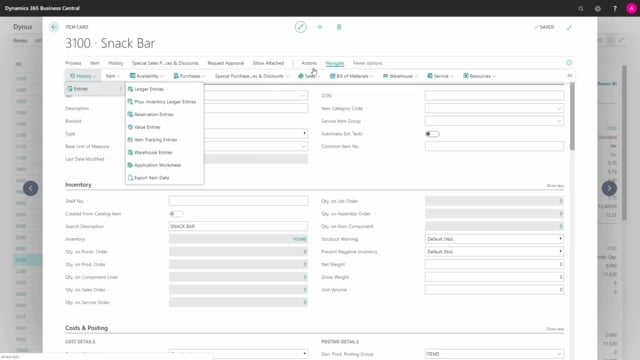


The item card in Business Central gives warehouse staff a range of actions for handling inventory, tracking, and counting. This article walks through the most relevant functions on the item card, what they do, and when you use them.
You access positive and negative inventory adjustments through the item journal, and you change location code or bin code through the item reclassification journal.
You view an item’s transaction history through item ledger entries, physical inventory ledger entries, item tracking entries, and warehouse entries.
You calculate counting periods directly from the item card so the item shows the last physical inventory date and the next counting period.
You can use item identifiers for simple references like GTIN numbers, but item cross references are the better choice when you need vendor- or customer-specific numbers.
Item journals for adjustments and reclassification
On the Process tab of the item card you find two journals that warehouse staff use often.
The item journal is where you post positive and negative adjustments. This is the typical journal you reach for when you work in the warehouse and need to correct quantities.
The item reclassification journal handles changes to existing inventory. You use it when you change the location code, the bin code, or similar information without changing the actual quantity.
History and ledger entries on the Navigate tab
The Navigate tab gives you access to the full history of an item.
The item ledger entries show all entries for the item. As a warehouse person, this is normally the first place you look.
The physical inventory ledger entries show the entries created when you post the physical inventory journal, meaning when you count the inventory. Here you see the adjustments made to the inventory after counting.
The item tracking entries are relevant when the item uses item tracking. These are essentially the item ledger entries filtered on item tracking information, so you can see all lot numbers and the remaining quantity for each.
The warehouse entries appear when the item is posted on a location set up as a warehouse location with bins. These entries relate to the item ledger entry but are shown at bin level, so you can see every transaction in the warehouse.
Item identifiers compared to item cross references
From the Actions menu you can enter item identifiers, but not many customers use this functionality. It works more or less the same as item cross references, only simpler.
If you want to add a simple reference such as a global trade item number (GTIN) to your item, you can enter it per item, per variant, and per unit of measure code.
The limitation is that you cannot define identifiers per vendor or per customer. For that reason, most people who need vendor- or customer-specific numbers use item cross references instead.
Calculate counting periods for physical inventory
Under Actions you also find a Functions window with the Calculate Counting Period functionality.
This works when your item is set up with a physical inventory counting period on the Warehouse tab. Once a counting period is assigned, you run Actions, Functions, Calculate Counting Periods, and the item card updates with the relevant information.
After running it, you can see the last physical inventory date, the date the counting period was last updated, the next counting period, and when that period starts and ends. You use these dates to plan and create counts in the warehouse.
Item tracing across hierarchies
The item tracing window lets you select an item number and trace it. In this window you can drill down into tracing hierarchies.
If you need to track a manufactured item from the sales side down into the components it is built from, you can trace both forward and backward in this window.
Bill of material and where-used
The Navigate tab also gives you the bill of material window, which can be useful in the warehouse.
If the item contains an assembly BOM, you can view it here. If the item itself goes into an assembly BOM, you use the Where-Used tab to see which items it is part of.
Bin content for items on warehouse locations
On the Warehouse tab you can view bin content. When the item is handled on locations with bins, the bin content list shows the quantity of the item in inventory across the different bins.
Q&A
What is the difference between the item journal and the item reclassification journal?
The item journal posts positive and negative adjustments to quantity. The item reclassification journal posts changes to existing inventory, such as changing the location code or bin code, without changing the quantity.
Where do I see the lot numbers and remaining quantity for an item?
Use the item tracking entries on the Navigate tab. These are the item ledger entries filtered on item tracking information, showing all lot numbers and the remaining quantity for each.
When should I use item cross references instead of item identifiers?
Use item cross references when you need vendor- or customer-specific numbers. Item identifiers only let you define references per item, per variant, and per unit of measure code, not per vendor or customer.
How do I update the counting period information on an item?
Set up the item with a physical inventory counting period on the Warehouse tab, then run Actions, Functions, Calculate Counting Periods. The item card updates with the last physical inventory date, the last counting period update, and the next counting period with its start and end dates.
How can I see how much of an item is stored in each bin?
Open the bin content list on the Warehouse tab. When the item is handled on locations with bins, the list shows the quantity in inventory across the different bins.