
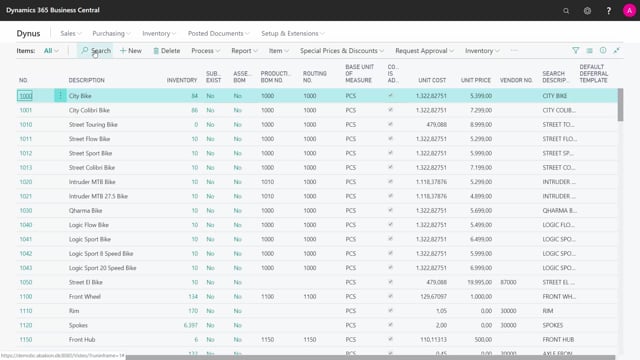


The replenishment fields on the item card control how Business Central creates production orders for manufactured items. The manufacturing policy decides whether to bundle several production order lines into one order (make-to-order) or create a separate order per line (make-to-stock). Around 99% of customers use make-to-stock.
The routing number defines the operations and work or machine centers needed to produce the item. The production BOM lists the components and quantities needed to build it. Together they work like a recipe: the routing is the steps, and the BOM is the ingredients.
The flushing method determines whether components are consumed manually in a consumption journal or automatically, either forward when you start the order or backward when you finish it. Overhead rate, scrap percentage, and lot size feed into the standard cost calculation. On the stock-keeping unit card you can override manufacturing policy, flushing method, components at location, and lot sizes per location.
Manufacturing policy: make-to-stock versus make-to-order
The manufacturing policy on the item card can be set to either make-to-stock or make-to-order. This setting has nothing to do with the planning parameters further down on the item card. It only controls how production orders are created.
With make-to-order, you bundle several production order lines into one production order. With make-to-stock, you create them separately, with one production order per line.
In practice, about 99% of customers use make-to-stock as their manufacturing policy. If you are unsure, this is not a setting worth spending much time on.
Routing number and production BOM
The routing number is selected from a list of routings that you set up. It describes the operations and the work centers or machine centers you need to perform in order to produce the item. Think of it as the list of steps you follow, like a recipe when you are cooking.
The production BOM is also selected from a list that you maintain. Here you add all the components and the quantity per unit that you need to build the item. To stay with the kitchen metaphor, the production BOM is your ingredients.
Rounding precision and flushing method
Rounding precision is used when production orders are created during planning. You can set it to round quantities into whole figures or another precision you prefer.
The flushing method controls how components are consumed when you create a production order. You can flush the components manually in a consumption journal, or you can flush them automatically. Automatic flushing happens either forward when you plan the production order, or backward when you finish it. In short, the flushing method determines whether components are consumed automatically or manually.
Overhead rate and scrap percentage in standard cost
Overhead rate and scrap percentage are used to calculate the standard cost for the item when you roll up the standard cost. They cover extra costs you want to add to the item rather than build into the routing.
For example, an overhead rate of two euros could represent a cost you do not want in your routing but want to add directly here on the production side. The scrap percentage works the same way. You set a normal percentage for the scrap you expect when producing the item in the production order, and that affects the standard cost, making the item more expensive.
Lot size and its effect on cost price
The lot size is used only for calculating the cost price. When you set a lot size of, for example, 80, and you have setup time in your routing, the lot size is used to calculate the standard cost based on that setup time spread across the lot.
Overriding replenishment parameters on the stock-keeping unit card
On the stock-keeping unit (SKU) card, where you have locations for an item, you can change some of the replenishment parameters, but not all of them. You can change the manufacturing policy, flushing method, components at location, and lot sizes.
The components at location field is worth noting. When you plan on a specific location on the SKU card, you can draw components into consumption journals automatically from other locations. When you refresh the production order, Business Central will suggest other locations to draw the components from.
Q&A
What is the difference between make-to-stock and make-to-order in Business Central?
Make-to-order bundles several production order lines into one production order. Make-to-stock creates them separately, with one production order per line. The setting only affects how production orders are created, not the planning parameters. Around 99% of customers use make-to-stock.
What does the flushing method control on a production order?
The flushing method controls whether components are consumed manually in a consumption journal or automatically. Automatic flushing can happen forward when you plan the order or backward when you finish it.
How do overhead rate and scrap percentage affect the item cost?
Both are used when you roll up the standard cost. They add extra costs to the item that you do not want to build into the routing, which makes the item more expensive in the standard cost calculation.
What is the lot size field used for on the item card?
The lot size is used only for calculating the cost price. Combined with the setup time in your routing, it determines how the setup cost is spread when calculating the standard cost.
Which replenishment parameters can you override on the stock-keeping unit card?
You can change the manufacturing policy, flushing method, components at location, and lot sizes per location. Not all replenishment parameters can be changed on the SKU card.
What does the components at location field do?
When you plan on a specific location on the SKU card, the components at location field lets you draw components into consumption journals automatically from other locations. When you refresh the production order, Business Central suggests the other locations to draw the components from.