
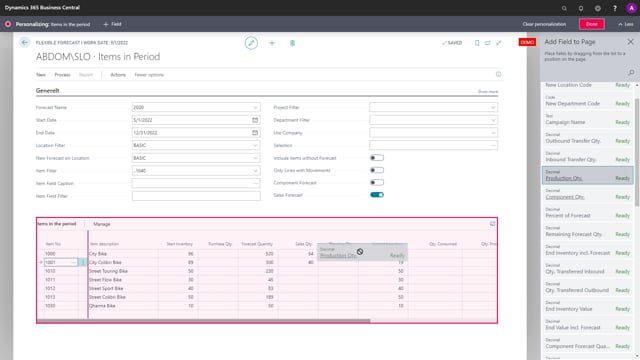


The flexible forecast in Business Central lets you enrich your planning data by adding extra columns to the forecast view. You add fields through standard Business Central personalization, so no development is needed.
You can add columns such as lowest inventory in the period, requisition quantity, purchase quantity, end inventory value, quantity produced, quantity consumed, and percentage of sales forecast used. This gives you a detailed planning overview in one place.
You can export the enriched view to Excel using standard Business Central functionality.
The extra columns are available in all three forecast views: many items in one period, forecast per dimension, and one item across many periods.
Enriching the flexible forecast with extra planning columns
If you use the flexible forecast to enrich your planning data, or simply to get a better overview of all kinds of planning data, you can add more than just the forecast figures. Alongside the forecast data, you can bring in other columns to build a more complex and detailed picture of your planning situation.
This is useful when you need to see the whole context around a forecast rather than the forecast numbers on their own.
How to add fields using standard personalization
When you enter the page, you use the standard Business Central personalization to add fields. Select the sub page, and you can see all the columns that are not yet added but could be. There is quite a lot to choose from.
Once you have added the columns you need, select Done, and you have a page with all the relevant columns in place.
Which columns you can add to the flexible forecast
The range of available columns covers most of what you need for detailed planning:
- Lowest inventory in the period – useful if you want to see how far the inventory dropped in a specific period.
- Requisition quantity – the quantity you want to acquire.
- Purchase quantity – with or without dimensions.
- Percentage of sales forecast used – so you can see how much of the sales forecast you have eaten.
- Component forecast and percentage of component forecast used – if you work with component forecast.
- End inventory value.
- Transfer quantities.
- Quantity produced and quantity consumed – if you have manufacturing.
- Production quantity and component quantity – the open quantities on production orders and production order component lines.
- Inbound and outbound quantities.
- Location code – which makes it possible to use this as a reclassification.
- Quantity to sell.
Once the columns are added, you get a detailed calculation. For example, the view can include the production quantity on an item along with whatever other quantities you have chosen to show.
Exporting the flexible forecast to Excel
One of the practical benefits of this approach is that the page is easy to export to Excel using standard Business Central functionality. That makes it simple to work with the detailed data outside the system when you need to.
Using the columns across all three forecast views
You can add these columns in all three views of the flexible forecast:
- Many items in one period
- Forecast per dimension
- One item across many periods
That means you get the same level of detail no matter how you choose to slice your planning data.
Q&A
How do you add extra columns to the flexible forecast in Business Central?
You enter the page and use standard Business Central personalization. Select the sub page, and you can see all the columns that are not yet added. Choose the fields you want and select Done.
Which planning columns can you add to the flexible forecast?
You can add lowest inventory in the period, requisition quantity, purchase quantity, percentage of sales forecast used, component forecast, end inventory value, transfer quantities, quantity produced, quantity consumed, production quantity, component quantity, inbound and outbound quantities, location code, and quantity to sell, among others.
Can you export the flexible forecast to Excel?
Yes. The page is easy to export to Excel using standard Business Central functionality, so you can work with the detailed data outside the system.
Which forecast views support these extra columns?
You can add the columns in all three views: many items in one period, forecast per dimension, and one item across many periods.