
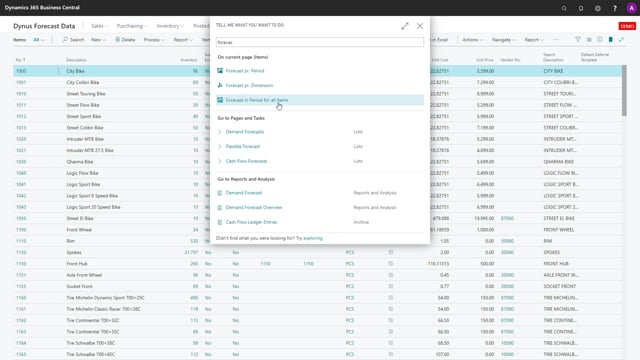


When you work with demand forecasts in Business Central, you can filter the forecast on items to see multiple items in one period. You can also apply filters on item numbers and on location. The location filter becomes hard to manage when you have many locations and want to combine several of them. The expanded header functionality solves this with two fields: location field caption and location field filter. These let you build a filter string automatically based on the fields in the location list, for example showing only locations where bin code is mandatory or where shipment is required.
You build the filter by selecting a field in the location list rather than typing each location code manually. This saves time and avoids errors when your forecast covers many locations.
Filtering forecasts on items and locations
When you use the forecast to filter on items, you can view many items within a single period. On top of that, you can add filters of varying complexity on the item numbers and on the location.
Here is a practical example. If you update your forecast with a location filter set to 520 on a city bike, you get one result. If you enter a different location instead, for example the WMS center, the quantities change accordingly, so the figure becomes 12. If you remove the location filter and calculate across all locations, the forecast updates with a blank location code. That blank line shows the sum, because in this case quantity exists only on those two locations.
Why manual location filtering becomes complex
This calculation gets complicated when you have many locations. Entering and combining location codes by hand quickly becomes tedious and prone to mistakes the more locations you manage.
Using location field caption and location field filter
When you expand the header functionality, you get access to a location field caption and a location field filter. These work with the fields on the location list.
For example, you can say you want to see only locations where bin code is mandatory. When you enter this in the field, Business Central builds a filter string on location for you. The forecast then shows only the locations that match that criterion.
You can do the same with other fields in the location list. If you want only locations that require shipment, you select that field and set the value to yes. The system again builds a filter string on those locations automatically.
With this functionality, you build filter strings on the locations you want to search for without having to enter each location code yourself.
Q&A
How do you filter a forecast on multiple items in Business Central?
You use the forecast to filter on items, which lets you view many items within a single period. You can add filters on the item numbers and on the location at the same time.
What happens to the forecast quantity when you remove the location filter?
When you remove the location filter and calculate across all locations, the forecast updates with a blank location code. That blank line shows the sum of the quantities across the locations that have quantity.
How do you filter a forecast on locations without typing every location code?
You expand the header functionality and use the location field caption and location field filter. You select a field from the location list, such as bin code mandatory or shipment required, and the system builds the filter string on the matching locations automatically.