
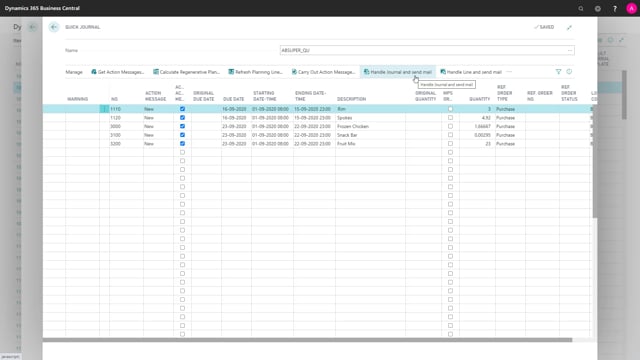


If you use both the Flexible Forecast app and the Reverse Planning app from AppSource, you can combine them to create supply orders directly from the Flexible Forecast view. This lets you plan manually for selected items while keeping a clear overview of demand and supply.
To plan for specific vendors, set a filter on the Vendor No. field in the item table. You can filter on several vendors at once, for example vendor 30000 and vendor 50000, and see all their items in a single view.
The Flexible Forecast view shows columns such as start inventory, quantity on purchase orders, and end inventory. You enter the quantity you want to supply for each item, then select Create Supply Orders. The quantities carry over to the quick journal line in the Reverse Planning tool, which creates one purchase order per vendor.
Combining Flexible Forecast and Reverse Planning
If you already use the Flexible Forecast and Reverse Planning apps from AppSource, you can use them together. The combination lets you create supply orders directly from the Flexible Forecast view, based on the forecast in a given period, for all the items you want to plan.
This is useful when you prefer to plan manually rather than running a planning worksheet. You still get a structured overview of your demands and supplies, and you can act on it without leaving the forecast view.
Filtering on vendors in the item table
You can narrow the view to the items you want to work with by setting a filter on the item table. For vendor-based planning, filter on the Vendor No. field.
You are not limited to a single vendor. As an example, you can plan for vendor 30000 and vendor 50000 at the same time. The view then shows all items from both vendors together, which gives you one consolidated overview to work from.
Entering quantities and reviewing inventory
The Flexible Forecast view gives you several columns to work with. You can see your start inventory, your quantity on purchase orders, your inventory, and more.
For each item, you enter the quantity you want to supply manually, in whatever amount you prefer. It is worth bringing out the End Inventory column as well, so you can see what your end inventory will be after the supply you have planned.
Creating supply orders across multiple vendors
When you are done entering quantities, select Create Supply Orders. The quantities carry over to the quick journal line, which is part of the Reverse Planning tool.
From there, the tool creates the orders for the vendors you planned for. In a scenario with two vendors, it creates two purchase orders, one per vendor.
This is a manual approach, but it gives you a clear overview of demand and supply and lets you create the right orders directly from that overview.
Q&A
Which apps do you need to create supply orders from the Flexible Forecast view?
You need both the Flexible Forecast app and the Reverse Planning app from AppSource. The Flexible Forecast view gives you the overview and the Create Supply Orders action, while the Reverse Planning tool handles the quick journal line and the actual order creation.
Can you plan for more than one vendor at the same time?
Yes. Set a filter on the Vendor No. field in the item table and include the vendors you want, for example vendor 30000 and vendor 50000. The view then shows all items from those vendors together.
How many purchase orders are created when you plan for two vendors?
The tool creates one purchase order per vendor. If you plan for two vendors, it creates two purchase orders.
How do you see the resulting inventory before creating orders?
Bring out the End Inventory column in the Flexible Forecast view. It shows what your end inventory will be after the quantities you have entered to supply.