
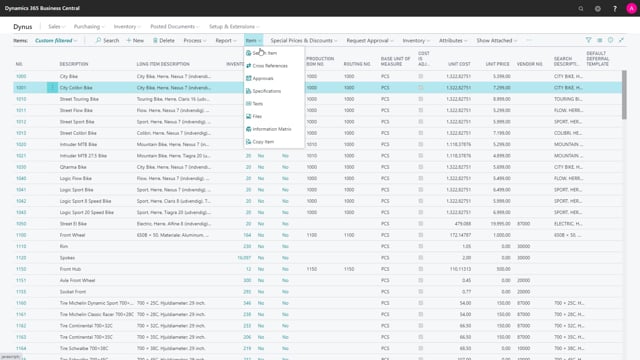


If you use the Master Data Information app from AppSource alongside the Flexible Forecast app, you can build forecasts based on the master data you have already enriched on your items, customers, and vendors. The Master Data Information table sits underneath the item table, so you can use it as a filter source when you make selections.
A practical example is a campaign. If you tag items with a campaign value such as “Christmas 2022” in Master Data Information, you can create a forecast selection that automatically pulls in every item belonging to that campaign.
To set this up, you create a selection where the related table points to the Master Data Information setup table. You then define key filters: the type field must be the option value for item, the information code must equal “campaign”, the information value must equal your campaign name, and the number field must equal the item number.
This requires the Flexible Forecast app to have a dependency on the Master Data Information app. The same approach works for third-party apps too, as long as the dependency is in place.
Using Master Data Information to enrich items, customers, and vendors
The Master Data Information app, available from AppSource, lets you enrich master data on your items, customers, and vendors. Because it stores this data in an underlying table linked to the item table, you can use those values as criteria elsewhere in the system, including in forecasting.
When you open an item, for example item number 1000, and you have the app installed, you can view the specification and define all kinds of criteria on your information. One of the criteria you can apply is a campaign.
Defining a campaign as an information value
You set up a campaign by creating an information value. You can build a long list of campaigns this way. As an example, you can create a campaign called “Christmas 2022” as an information value.
You can then apply that campaign to many different items. If you look in the information matrix, you can see which items belong to the Christmas campaign. In this case, eight to ten items are tagged as part of the Christmas campaign through the Master Data Information app.
Building a forecast selection based on a campaign
Once your items are tagged, you can use the campaign as a selection in the forecast per period for all items. Here is how to configure it:
- Create a selection and name it, for example “Christmas campaign”.
- Set the related table to the Master Data Information setup table. You need to know the name of that table, and you can zoom on the table to find it.
- Set up the key filters. The first filter, the type field on the information setup table, needs to be the expression value for item. In this example that is option value 1. If you do not know the option value, you can try the values and see which one corresponds to item, then enter it.
- Set the information code field to equal the value “campaign”.
- Set the information value field to equal “Christmas 22”.
- From the source table, set field number 2, the number field, to equal the item number.
With this in place, the forecast selection automatically applies to every item that carries the campaign value.
Dependency requirements for combining apps
To make this work, the Flexible Forecast app must have a dependency on the Master Data Information app. As long as that dependency exists, you can set up information in the forecast and run flexible forecasts driven by another app. The same principle applies to third-party apps. If the Flexible Forecast app has a dependency on a third-party app, you can use values from that app as a forecast selection too.
Q&A
Can I use Master Data Information values as a basis for forecasting?
Yes. Because the Master Data Information table is linked to the item table, you can use enriched values such as a campaign as a selection criterion in the Flexible Forecast app.
How do I make a forecast that covers all items in a campaign?
Create a selection where the related table is the Master Data Information setup table, then define key filters: set the type field to the option value for item, the information code to “campaign”, the information value to your campaign name, and the number field to the item number.
What do I do if I do not know the option value for the type field?
You can try the available values and see which one corresponds to item. Once you confirm it, for example option value 1, you enter that value in the filter.
What dependency is required to combine Flexible Forecast with Master Data Information?
The Flexible Forecast app must have a dependency on the Master Data Information app. The same applies if you want to base forecasts on a third-party app.