
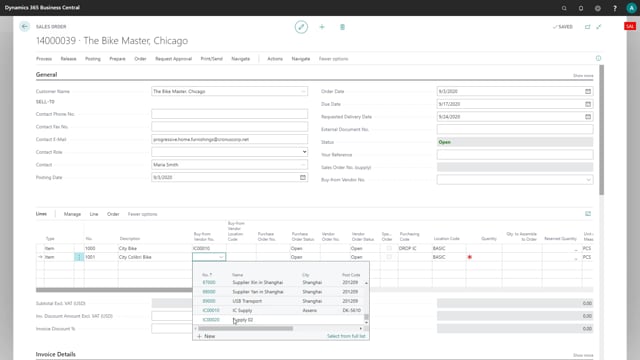


If you run one sales company that buys from several supply companies, you can create a single sales order that automatically generates separate purchase orders for each supplier. This is handled through intercompany functionality in Microsoft Dynamics 365 Business Central.
You enter the items on the sales order and assign a different vendor to each sales line. When you release the order, Business Central creates one purchase order per supplier. Each purchase order then becomes a sales order in the corresponding supply company.
This setup is useful when you have one sales company and multiple supply companies, and you need parts of the same customer order delivered from different suppliers.
One sales company with multiple supply companies
A common scenario is having several supply companies serving just one sales company. The customer places a single order with your sales company, but the goods need to come from different supply companies depending on what is ordered.
To handle this, you create one sales order in your sales company with multiple sales lines. Each line can be tied to a different supply company. When you release the order, Business Central creates a separate purchase order for each supply company involved.
So a single sales order in your sales company can generate two purchase orders that go to two different suppliers.
Creating the sales order in Business Central
In the sales company, you start a sales order the same way you normally would. You enter the customer and the requested delivery date, then add the items the customer wants.
The key step is assigning the supplier per line. For example, you can set the first item, a bike, to be sent from Supply Company 1. On the next line, you assign a different item to be sent from your other supply company.
At this point the order has two sales lines with two different vendor numbers and the quantities for each. The supplier assignment on each line tells Business Central where the purchase order should be created.
What happens when you release the order
When you release the sales order, Business Central creates two purchase orders, one for each supplier. After release, you can see two different purchase order numbers and two different vendor order numbers on the sales order.
The vendor order numbers are the sales order numbers created automatically in your two supply companies. In other words, the purchase order in the sales company links directly to a matching sales order in each supply company.
From the sales line you can drill into the purchase order for Supplier 1, then go back and check the next line to see the purchase order for your other supplier. Each line keeps its own connection to the correct supply company.
Q&A
Can one sales order be supplied by multiple supply companies in Business Central?
Yes. You create one sales order in your sales company with multiple sales lines and assign a different vendor to each line. When you release the order, Business Central creates a separate purchase order for each supply company.
How do you assign different suppliers to lines on the same sales order?
You enter each item on its own sales line and set the vendor on that line. For example, one line can be sent from Supply Company 1 and the next line from another supply company.
What happens when you release a sales order with multiple supply companies?
Business Central creates one purchase order per supplier. You then see two different purchase order numbers and two different vendor order numbers on the sales order, where the vendor order numbers are the sales orders created automatically in the supply companies.