
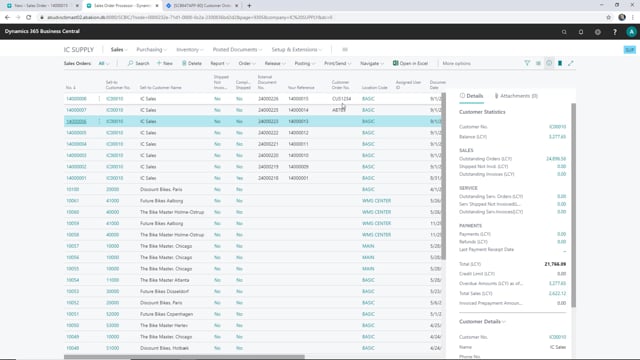


When you work with intercompany orders in Business Central, keeping track of document and order numbers becomes critical. You are juggling several sets of numbers at once: your own numbers in the sales company, the numbers in the supply company, and the customer’s own order number. The good news is that Business Central carries these numbers through the whole chain automatically, so you can trace any order across both companies.
You enter the customer’s order number in the External Document Number field on the sales order in your sales company. When you release the order, that number is printed on the sales order document in the supply company. At the same time, the purchase order number and the sales order number are entered automatically on the sales order in the sales company.
Once you release the order, the purchase order number appears automatically on the order, along with the sales order number, and your customer’s number is still there as well. You end up with all the relevant numbers visible in one place.
On the sales order list in the supply company, you can see the same numbers reflected back. The External Document Number on that list is the purchase order number from your sales company. You also have the sales order number from the sales company, and the customer’s order number. Every number is tracked on both documents, so you can follow an order from end to end without losing the thread.
How intercompany number tracking works in Business Central
The mechanism is straightforward in practice. You start in the sales company by recording the customer’s order number in the External Document Number field. Releasing the order triggers the automatic flow of numbers between the two companies. Business Central populates the purchase order number and the sales order number on the sales order in the sales company, and it prints the customer’s order number onto the sales order document in the supply company.
This means that whether you look at the documents in the sales company or in the supply company, you can match them up. The purchase order number in the sales company shows up as the external document number in the supply company, which gives you a clear reference point across both ends of the transaction.
Why this matters for intercompany order management
With multiple companies involved in a single transaction, it is easy to lose track of which number belongs to which document. By carrying the numbers all the way through from the sales company to the supply company, you keep full traceability on both documents. When a customer asks about an order, or when you need to reconcile a purchase order against a sales order in another company, the numbers are already there and connected.
Q&A
Where do you enter the customer’s order number on an intercompany sales order?
You enter the customer’s order number in the External Document Number field on the sales order in your sales company.
What happens to the order numbers when you release an intercompany order?
When you release the order, the purchase order number and the sales order number are entered automatically on the sales order in the sales company. The customer’s order number is also printed on the sales order document in the supply company.
What does the External Document Number show on the sales order list in the supply company?
On the sales order list in the supply company, the External Document Number is the purchase order number from your sales company.
Which numbers can you track across both intercompany documents?
You can track the sales company’s sales order number, the purchase order number, and the customer’s order number on both the sales company document and the supply company document.