


Creating a customer in Microsoft Dynamics 365 Business Central is a straightforward process you handle from the Customers list. You assign a customer number, fill in the name and address, and then set up the fields that control how the customer behaves in sales, posting, payments, and reminders. Mandatory fields are marked with a small red dot, and the system validates key entries like the VAT registration number as you type.
You reach the Customers list from your Role Center under Sales. From there, you click New to open a blank Customer Card and start entering data.
Some fields are required and some are optional. The required fields include the General Business Posting Group, which controls how transactions for the customer are posted. Optional fields let you tailor the customer to your needs, for example a Salesperson Code, a Language Code, payment terms, or a default location code.
Creating a new customer from the Customers list
From your Role Center, go into Sales and select Customers. This brings you to the Customers list. Click New to create a new customer.
You can enter a customer number manually or let a number series assign it automatically. Then you give the customer a name, for example “The Bikemaster in Copenhagen”.
Filling in customer details and address
On the Customer Card you work through the available fields. You can fill in the address, for example “Pedal Street, number 3”, along with a post number. When you enter the post number, Business Central recognises the matching city and fills it in by default.
You can add a Contact Name directly, such as “Graham Bell”, together with a phone number, an email address, and a web page. If you want to use the Contact Table instead, you use the Primary Contact Code.
You can also set a Salesperson Code and a Language Code. The Language Code matters if you want to print reports in the customer’s own language, for example for a Danish customer.
VAT registration number and field validation
You can enter a VAT registration number on the Customer Card. Business Central validates the number against rules that depend on the country and the customer. In Denmark, for example, the VAT registration number must be eight digits. This built-in validation checks the data you enter and helps you catch errors early.
Mandatory fields and posting setup
The mandatory fields are marked with a small dot. The General Business Posting Group is one of these required fields, and you need it in place for the customer to post correctly.
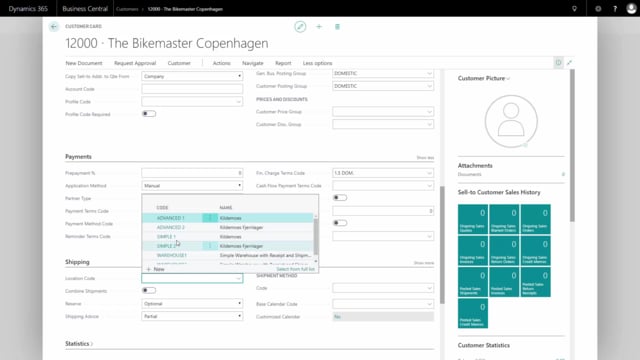
Beyond the mandatory fields, you can configure how the customer is handled financially. You can assign a customer price group, a Payment Terms Code, and a Payment Method Code that defines how the customer pays. You can also control how reminders are sent and how finance charges are calculated. All of this is set up directly on the customer.
Setting a default location code
If you want, you can assign a default location code for the customer. This sets the location that is used by default whenever you work with the customer.
Finishing the customer card
When you have filled in the fields you need, go back or press Escape. The new customer is now created and ready to use.
Q&A
How do you create a new customer in Business Central?
From your Role Center, go into Sales and select Customers to open the Customers list. Click New, assign a customer number manually or through a number series, give the customer a name, and fill in the relevant fields on the Customer Card. When you are done, go back or press Escape, and the customer is ready to use.
Which fields are mandatory when creating a customer?
Mandatory fields are marked with a small dot on the Customer Card. The General Business Posting Group is one of the required fields, because it controls how transactions for the customer are posted.
How does Business Central validate the VAT registration number?
Business Central checks the VAT registration number against rules that depend on the country and the customer. In Denmark, the VAT registration number must be eight digits. The validation runs as you enter the data and helps you catch errors.
Can the city be filled in automatically when creating a customer?
Yes. When you enter the post number, Business Central recognises the matching city and fills it in by default.
What does the Language Code on a customer do?
The Language Code lets you print reports in the customer’s own language. You set it on the Customer Card, for example for a Danish customer.
What payment-related settings can you configure on the customer?
You can set a Payment Terms Code, a Payment Method Code that defines how the customer pays, a customer price group, how reminders are sent, and how finance charges are calculated. All of this is set up directly on the customer.