


If you post shipments and invoices as separate steps in Business Central, you can collect several posted shipments to the same customer onto a single sales invoice. You do this by creating a sales invoice manually and using the Get Shipment Lines function to pull in the open, uninvoiced shipment lines from multiple sales orders.
The function shows all posted shipment lines that have not yet been invoiced. You can select individual lines or all of them, and the invoice records which shipment number each line came from. This reference also appears on the printed invoice.
After invoicing, the sales orders stay open until shipment and invoicing match. You then delete them manually or use the report that deletes fully shipped and invoiced sales orders in bulk.
Combining shipments from several sales orders onto one invoice
When you work with sales orders in Business Central, you can post shipment and invoicing as two separate functions. That gives you the option to combine the invoicing after you have posted several shipments to the same customer. Instead of invoicing each sales order on its own, you make one sales invoice that collects the posted shipment lines from multiple orders.
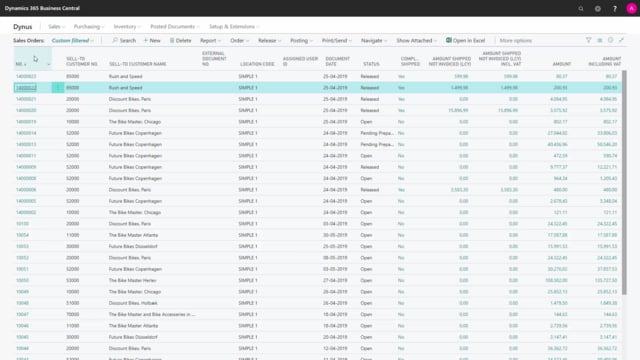
Take an example with two sales orders for the same customer. The first order has two lines with quantities 10 and 8, both shipped, and the quantity to invoice is still 10 and 8, so nothing has been invoiced yet. The second order has three lines with different quantities, also shipped but not invoiced. The goal is to bundle both orders into a single sales invoice.
Using Get Shipment Lines on a sales invoice
Start by creating a new sales invoice manually for the customer. Once you have made the header, go to the lines and use the function Get Shipment Lines. This displays all the open shipment lines that have not been invoiced.
You decide how much to include. You can select a single line, a few lines, or everything. When you confirm, the lines are imported into the sales invoice and it is ready for posting.
After you post the invoice, open it to see the result. The invoice combines the lines and shows which shipment numbers they came from, for example one line from one shipment number and another line from a different shipment number. That reference carries through to the printed invoice as well.
Closing the sales orders after combined invoicing
Once the combined invoice is posted, the original sales orders remain open. If you check the quantities, you will see that the quantity invoiced now matches what was shipped, for example 10 and 8.
To clean up, you have two options. You can delete each sales order manually, or you can run the report that deletes sales orders where the quantity shipped and the quantity invoiced are fully completed. The report removes those orders in one go.
Q&A
How do I combine shipments from several sales orders onto one invoice in Business Central?
Create a sales invoice manually for the customer, go to the lines, and use the Get Shipment Lines function. It shows all open, uninvoiced shipment lines, and you can select lines from multiple sales orders to combine them onto a single invoice.
Does the combined invoice show which shipments it came from?
Yes. The invoice records the shipment numbers for each line, and these references also appear on the printed sales invoice.
What happens to the sales orders after I post the combined invoice?
The sales orders stay open even though the quantity invoiced now matches the quantity shipped. You either delete them manually or use the report that deletes sales orders where shipment and invoicing are fully completed.
Can I invoice only some of the posted shipment lines?
Yes. When you use Get Shipment Lines, you can select a single line, several lines, or all of the open shipment lines, depending on what you want to invoice.