
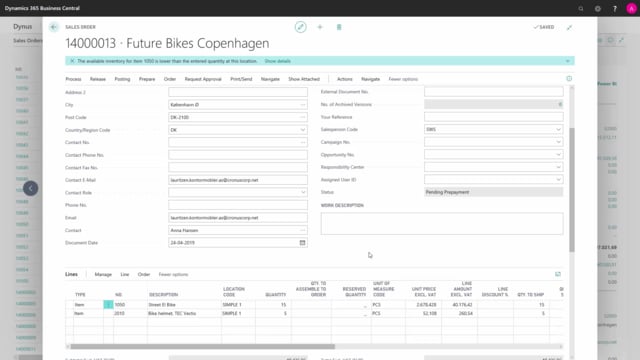


Prepayment invoices in Microsoft Dynamics 365 Business Central let you ask a customer to pay all or part of a sales order in advance. You set a prepayment percentage on the customer, the item, or directly on the sales order, and Business Central generates a separate prepayment invoice you can send before you ship the goods.
You can set the prepayment percentage per line so different items carry different percentages, or apply one percentage to the whole order. When you change the order percentage, Business Central asks if you want to update the lines.
Use the Compress Prepayment option to combine prepayment lines that share the same general ledger account or dimensions into a single invoice line. If you leave it off, you get one prepayment line per item, which makes it clearer to the customer which prepayment belongs to which product.
You can add more items to an order after you have already posted a prepayment invoice. Release the order, change the quantities, and post a new prepayment invoice. Business Central creates a second prepayment invoice that covers only the added amount.
You cannot delete a sales order that has a prepayment invoice attached. To reverse it, post a prepayment credit memo.
In the Sales & Receivables Setup you can require that a sales order cannot be posted before the prepayment has been paid. You can also set the prepayment status to update automatically.
Setting up prepayment percentages on a sales order
From a sales order, you can create a prepayment invoice when you want the customer to pay in advance. You can set up prepayments on the item and on the customer, but you can also apply them directly on a specific order.
A typical scenario is an order for a number of very expensive bikes where prepayment is not part of your usual routine, but you want it for this particular order. You enter the customer information and the items the customer requested, then decide how to handle the prepayment.
You can specify the prepayment percentage per line or for the whole document. On the line, you can add different prepayment percentages to each item. If the Prepayment % column is not shown, right-click on the header, choose Choose Columns, find Prepayment % in the list and add it.
To use the same percentage for all lines, type the percentage in the Prepayment section of the order. Business Central then asks whether you want to update the lines.
In the same section you can set the payment terms for the prepayment, when it is due, and any payment discount that applies to the prepayment.
Compressing prepayments into a single invoice line
The Compress Prepayment option controls how prepayment lines are combined. When you turn it on, prepayments on the sales order are merged if they share the same general ledger account for prepayments or the same dimensions.
With Compress Prepayment turned on, the prepayment invoice collects everything into one line. You can then print and send the document to the customer.
If you do not use compressed prepayments, you get one line per item on the prepayment invoice. Each line shows only the amount you need as prepayment for that item. This makes it easier for the customer to see which prepayment relates to which item.
Posting a prepayment invoice
To create the prepayment invoice, go to Actions, then Posting, then Post Prepayment Invoice, and post it.
To open the posted invoice, go to Navigate, then Prepayment, then Prepayment Invoices. From there you can print the document and send it to the customer.
Back on the sales order, open the General tab and choose Show more. The status now reads Pending Prepayment. In the Sales & Receivables Setup you can configure the prepayment status to update automatically.
Adding items after a prepayment invoice is posted
If the customer calls the day after placing the order and you have already created a prepayment invoice, you can still add more items. Release the order, change the quantity on the lines, then go to Actions, Posting, Post Prepayment Invoice.
When you check Navigate, Prepayment, Prepayment Invoices, you now see two prepayment invoices. The second one covers only the added prepayment amount. The order returns to the status Pending Prepayment.
Controlling when a sales order can be posted
In the Sales & Receivables Setup you can require that a sales order cannot be posted until the prepayment has been paid. If you do not set this up, you can post the sales order like any other order.
Deleting an order and creating prepayment credit memos
You cannot delete a sales order that has a prepayment invoice connected to it. To reverse the prepayment, create a prepayment credit memo under Actions, Posting, Post Prepayment Credit Memo.
Q&A
How do you create a prepayment invoice from a sales order in Business Central?
Set a prepayment percentage on the order or on the lines, then go to Actions, Posting, Post Prepayment Invoice and post it. You can open and print the invoice under Navigate, Prepayment, Prepayment Invoices.
Can you set different prepayment percentages for different items on the same order?
Yes. You can add a different prepayment percentage to each line. If the Prepayment % column is hidden, right-click the header, choose Choose Columns, and add it.
What does the Compress Prepayment option do?
It combines prepayment lines that share the same general ledger account or the same dimensions into a single invoice line. If you leave it off, you get one prepayment line per item, which makes it clearer to the customer which prepayment relates to which item.
Can you add items to an order after a prepayment invoice has been posted?
Yes. Release the order, change the quantities, and post a new prepayment invoice. Business Central creates a second prepayment invoice that covers only the added amount.
Can you delete a sales order that has a prepayment invoice?
No. You first have to create a prepayment credit memo under Actions, Posting, Post Prepayment Credit Memo.
Can you prevent a sales order from being posted before the prepayment is paid?
Yes. In the Sales & Receivables Setup you can require that the order cannot be posted until the prepayment has been paid. If you do not set this up, you can post the order like any other sales order.