


Dimensions in Microsoft Dynamics 365 Business Central let you tag transactions with attributes like department, project, or customer, so you can analyse your financial data across more than just the chart of accounts. You set up dimension values, assign default dimensions to customers or vendors, and the values follow automatically onto sales orders, invoices, and ledger entries.
You can define as many dimensions as you need, but only two can be global dimensions. Global dimensions are set up directly in the chart of accounts and shown in the General Ledger Setup. Changing which dimensions are global is a large exercise, not a quick edit. Dimensions that are not global become shortcut dimensions, and you analyse them using dimension analysis.
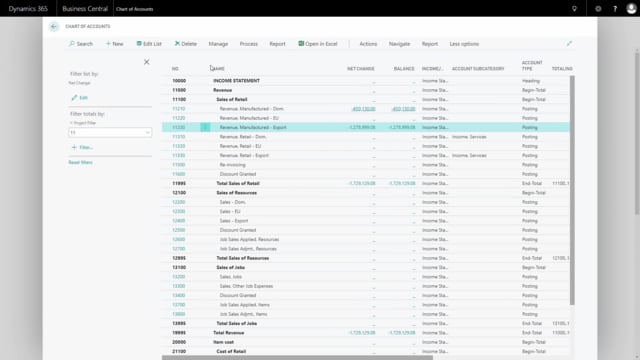
To filter the chart of accounts by a dimension, you add a totalling filter, for example a project filter with a specific dimension value, and you then see the net change for that dimension and can drill into all related entries.
How dimensions work in Business Central
Dimensions are a reporting tool. They let you attach values like department or project to your postings, so you can later see your numbers broken down by those values. The example below walks through adding a new dimension value, assigning it to a customer, posting a sales order, and seeing the result in the chart of accounts.
To find your dimensions, go to the search and look for dimensions. In this example there are already two dimensions defined: department and project. You can define as many dimensions as you want, but only two of them can be global.
Adding a new dimension value
Select the dimension you want to extend, in this case project, and from the dimension tab go into dimension values. These are the values that belong to that dimension.
Add a new value, for example number 49 called Miscellaneous. This value is going to be used for a customer, but the same approach applies to vendors and other records that use dimensions.
Assigning a default dimension to a customer
Open the customer list and select the customer, in this example Rush and Speed, which has no dimension setup yet. From the customer card, navigate to set up the dimensions.
Here you define the default dimensions for the customer. Add project number 49 as a default dimension. The customer now has this default dimension, and it transfers automatically to all types of documents created for that customer. You can still change it on a specific document if you need to.
Posting a sales order with dimensions
Create a new sales order for the customer to generate postings that will reach the chart of accounts. When you add the customer, the default dimension appears on the sales order header. Add the item number and quantity.
To view or edit the dimensions on the order, go to Navigate, Orders, and you can see the dimensions transferred from the customer to the sales order. In this example the dimensions are left unchanged.
Post the sales order with both ship and invoice so it makes a financial impact as well.
Seeing the dimension in the chart of accounts
Go to the chart of accounts to see the net change. Add a dimension filter by setting a totalling filter, in this case a project filter with the value 49.
You now see the amount in the chart of accounts that came from this sales order, tied to that dimension value. From there you can navigate into all the entries that carry that dimension. You can do the same for your other dimensions and pull the numbers for each one, which is what makes dimensions a reporting tool.
Global dimensions and shortcut dimensions
Two dimensions can be global. Global dimensions are set up directly in the chart of accounts, and you can see them in the General Ledger Setup, where a fast tab shows the two global dimensions.
Changing which dimensions are global is not something you do casually. It is a big exercise. To do it, go to functions and change global dimensions, where you select the new dimensions to become global. Dimensions that are not global act as shortcut dimensions, and you evaluate them using dimension analysis.
Q&A
How many global dimensions can you have in Business Central?
You can define as many dimensions as you need, but only two of them can be global. Global dimensions are set up directly in the chart of accounts and shown in the General Ledger Setup.
What happens to a default dimension assigned to a customer?
The default dimension transfers automatically to all types of documents created for that customer. You can still change it on a specific document when needed.
How do you filter the chart of accounts by a dimension value?
Open the chart of accounts and add a totalling filter for the dimension, for example a project filter with a specific value. You then see the net change for that dimension and can drill into all related entries.
What is the difference between global and shortcut dimensions?
Global dimensions are set up directly in the chart of accounts and are limited to two. Dimensions that are not global become shortcut dimensions, which you evaluate using dimension analysis.
Is it easy to change which dimensions are global?
No. Changing global dimensions is a big exercise. You do it through functions and change global dimensions, where you select the new dimensions to become global.