
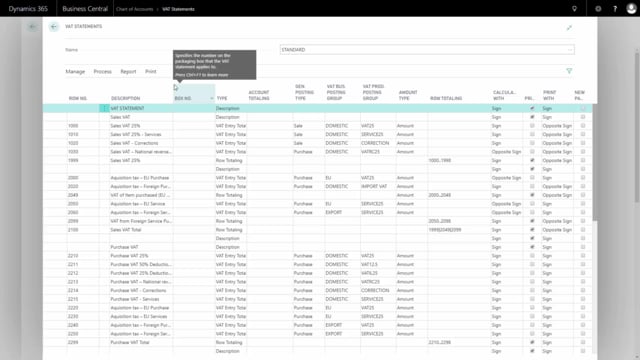


Settling VAT in Business Central is a straightforward batch job run from the VAT statement. This article walks through the full flow: how to calculate and post the VAT settlement, how to verify the figures before posting, and how to register the actual payment to the authorities.
You settle your VAT from the VAT statement using the Calculate and Post VAT Settlement batch job. This collects all open VAT entries in a period and moves them to your VAT settlement account or VAT payables account.
Before posting, you can preview the settlement or print a detailed VAT statement to a PDF for your archive. The preview shows the full detail per group, while the posted settlement collapses the groups and shows only the totals.
The VAT settlement and the VAT payment are two separate steps. Posting the settlement does not pay your VAT. You pay it later through the general journal, typically on the date the money actually leaves your bank.
How VAT appears in the chart of accounts
In the chart of accounts, your VAT accounts are grouped together in one section. The VAT payables account (in this example, account 94175) shows zero when you have no outstanding VAT that has been calculated but not yet paid.
All VAT calculated from the period up until now sits in the VAT accounts. When you run the settlement, these amounts are collected and moved to the VAT payables account, ready to be reported and paid.
Previewing the VAT settlement before posting
Before you run the settlement, it is good practice to check the amounts. From the VAT statement you can open the preview to see what the figures will look like.
You can also print the preview to a PDF and save it. This gives you the detailed VAT statement with all the lines, so you have a full record of the actual figures behind your VAT.
Keep in mind the difference between the two outputs. The detailed VAT statement shows every line, while the calculated settlement collapses all the groups into totals.
Running Calculate and Post VAT Settlement
From the Calculate and Post VAT Settlement batch job, you set up the parameters:
- Starting date and ending date for the period you want to settle.
- Posting date. Many accountants post on the last date of the period, but that is up to you.
- Settlement account that everything will be settled into.
The batch job takes all the open VAT entries in that period and moves them to your settlement account. You can preview the result before actually posting it. When you are satisfied, you select Post, and the system posts all your VAT into the settlement account or payables account.
After posting, you get the VAT settlement document, which you can print and save in an archive if you wish. Going back to the chart of accounts, you can see the settled amount. In this example, 135,000 is now in the VAT payables account.
Reporting and paying the VAT to the authorities
The posting date for the settlement will normally not be the date you actually pay. Once the settlement is posted, you report to the authorities based on it. You report all your sales VAT, purchase VAT, acquisition tax, and so on.
The authorities bill you with a due date. When that date arrives, you go in and pay your VAT payables. In the VAT payables account you can also see the outstanding amount for the period you are currently in, which should not be settled yet.
Registering the VAT payment in the general journal
When you actually pay your outstanding VAT payable, you go into the general journal. You select the VAT payables account and enter the amount that was settled. As the balancing account, you use your bank account if that is where you are paying from.
Fill in the correct dates and descriptions. The date here is the day you make the physical payment from the bank for your VAT.
Once this is posted and you look back into the G/L account, the VAT payables account is back to zero. What remains is the outstanding VAT for the current period, which you will settle and pay in the next cycle.
Q&A
Where do you settle VAT in Business Central?
You settle VAT from the VAT statement, where you run the Calculate and Post VAT Settlement batch job. It collects all open VAT entries in a period and moves them to your VAT settlement or payables account.
Does posting the VAT settlement also pay the VAT?
No. The settlement and the payment are separate steps. Posting the settlement moves the VAT to the payables account. You pay it later through the general journal, on the date the money actually leaves your bank.
How do you check the VAT figures before posting?
You open the preview from the VAT statement to see the amounts. You can also print a detailed VAT statement to a PDF and save it. The detailed statement shows every line, while the posted settlement shows only the totals per group.
What date should you use as the posting date for the VAT settlement?
Many accountants post on the last date of the period, but you can choose the date that suits your process. The posting date is normally not the same as the date you actually pay the VAT.
How do you register the VAT payment?
You go into the general journal, select the VAT payables account, and enter the settled amount. As the balancing account, you use your bank account. Set the date to the day you make the physical payment. After posting, the VAT payables account returns to zero.