
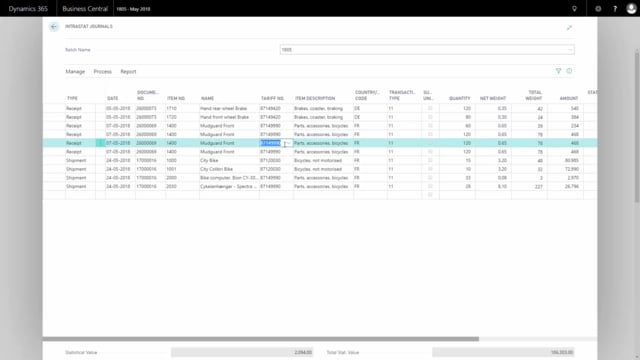


If your company sells or buys goods across borders within the EU, you may be required to report Intrastat to your local authorities. In Denmark, this means reporting to Danish Statistics every month. This article explains how to handle Intrastat reporting in Business Central, from setting up the journal to generating the file you send to the authorities.
You report Intrastat per item and per country. For every customer you sell to and every vendor you buy from in another EU country, you report the amounts and weights of the goods you handle. Business Central can calculate these lines automatically if you have set up your master data correctly.
The system bundles your reporting lines by combination of tariff number and country/region code, and shows total weight and total quantity for each combination. You can print the journal, create a report file, and Business Central automatically marks the journal as reported.
Before you can report, each item needs a net weight and a tariff number, and your sales and purchase documents need transaction types. If these are missing, the journal will complain when you try to report.
What Intrastat reporting requires
Intrastat is a reporting obligation that applies depending on your company size and where you are located. In Denmark, someone in the company handles this reporting to Danish Statistics every month.
The reporting is done per item and per country. For all the customers you sell to and all the vendors you buy from in countries that are part of the agreement, for instance other EU countries, you report the amounts and the weights of the goods you handle.
Setting up the Intrastat journal in Business Central
You work with Intrastat in the Intrastat journal. The normal approach is to set up a batch name per month, where you define the year and month. You typically leave the lines in the journal afterwards so you keep the history, but you can delete the journal if you want to.
When you create a journal for a new period, you select the statistics period as year and month. This must be defined with four digits, following the month. For example, May 2018 is entered as 1805. If you enter something else, such as an extra digit, Business Central tells you the entry is wrong. The four digits have to be correct.
Calculating and suggesting Intrastat lines automatically
Once the journal is set up, you let Business Central calculate or suggest the lines. It suggests lines based on your sales and purchases for that month, and it defaults to the correct month, so the work is done automatically.
The system suggests lines to report for both receipts and shipments. This works smoothly because of the master data you have in place:
- Tariff numbers defined on all items
- Country codes coming from your sales and purchases
- Transaction types defined on your customers and on your sales and purchase documents
- Net weight set up on all items
If the net weight or tariff number is missing, the system complains when you try to report. You have to enter net weight and tariff number, and it is much better to have these already on the items rather than filling them in manually in the journal each time.
Printing and reviewing the Intrastat report
The next step is to print the journal to the screen so you can review it. You can print receipts and shipments separately, which gives you two different prints to report to the authorities.
When you print, the lines are bundled by combination of tariff number and country/region code. For example, you might have six receipt lines in the journal that print as only two lines, because the report groups by country/region code per tariff number. Each printed line shows the total weight and the total quantity for that combination. That bundled view is exactly what you report.
The same logic applies to shipments. In one case the lines may all be the same country but with different tariff numbers, so they are bundled accordingly.
Creating the file for reporting
If you want to report more easily, you can create a file directly from the journal. When you create the file, Business Central suggests the file you can use for the reporting. Normally you save both the file and the PDF you printed.
After you create the file, the journal automatically gets a checkmark in the Reported field. You can still delete the journal and its lines if you want to, but most customers using this functionality simply leave the journal in place so they keep the history.
Q&A
What format must the statistics period use in the Intrastat journal?
The statistics period must be year and month, defined with four digits following the month. For example, May 2018 is entered as 1805. If you enter an extra digit or anything else, Business Central rejects it as incorrect.
What master data do I need before I can report Intrastat?
You need a tariff number and a net weight on all items, country codes coming from your sales and purchases, and transaction types defined on your customers and on your sales and purchase documents. If net weight or tariff number is missing, the system complains when you try to report.
How are Intrastat lines grouped when printed?
Lines are bundled by the combination of tariff number and country/region code. Several journal lines can print as fewer report lines, with each line showing the total weight and total quantity for that combination.
What happens to the journal after I create the report file?
The journal automatically gets a checkmark in the Reported field. You can still delete the journal and its lines, but most customers leave it in place to keep the history.
Can I report receipts and shipments separately?
Yes. You can print and report receipts and shipments as two separate outputs to send to the authorities.