
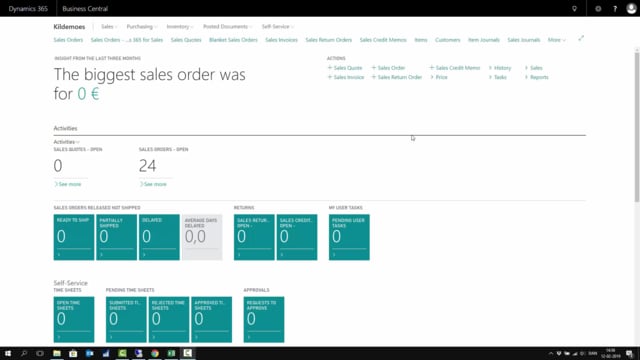


In Business Central you can create a sales invoice to bill a customer for items, resources, goods, or directly on a G/L account. This article walks through the full process: from entering the customer and invoice lines, to checking statistics, previewing the posting, and reviewing the documents that get created when you post.
When you enter a customer number on the invoice header, Business Central fills out most of the header fields automatically from the customer card. This includes invoice details, shipping and billing information, and the currency code.
You can mix several line types on the same invoice. A G/L account line posts directly to a general ledger account. An item line pulls the price from the item card and the sales price table. A resource line lets you invoice work such as repair hours, with the hourly rate coming from the resource card.
Before posting, you can review the sales invoice statistics and run a preview posting. The preview shows every entry that will be created, including G/L entries, customer ledger entries, item ledger entries, resource entries, and VAT entries, without actually posting anything.
When you post, Business Central creates a posted sales invoice and, if you shipped items, a separate posted sales shipment with its own document number. You can send the invoice to the customer from the posted document, and you can navigate from the posted documents to see the related ledger entries.
Creating a sales invoice and entering the customer
From the main menu, go into Sales Invoices and create a new sales invoice. In the header, enter the customer number you want to invoice.
As soon as you enter the customer number, many fields on the invoice header are filled out automatically from the customer card. If you press Show More, you can see all the header fields, and many of them come straight from the customer. Scroll down and you also see the invoice details, shipping and billing information, all pulled from the customer.
In this example the customer is set up with the currency code Euro, so the invoice uses Euro as well.
Using different sales invoice line types
Once the header is ready, you enter the invoice lines, and you can choose different types depending on what you are selling.
- G/L account: Use this when you sell directly on a general ledger account. For example, you can sell on your sales account for retail in EU, enter a quantity and a description such as a software update or software service, and set a price like a hundred Euro.
- Item: Use this when you sell a physical item to the customer, for instance three bikes. The price comes from the item card by default, according to the sales price table, where you can set specific prices for specific customers.
- Resource: Use this when you sell work, for example a repair you did in your repair shop on a bike. Select Resource, enter the resource number, and the description fills in automatically. You enter the number of hours, and the hourly rate comes into the line by default from the resource card.
Checking statistics before posting
When the invoice is ready, it is a good idea to check the figures before you post. From the sales header, on the Invoice tab, open the statistics to see the amounts on the invoice. This lets you confirm everything looks correct, and you can see the amounts in your local currency as well.
Running a preview posting
To see exactly what posting the invoice will do, use the preview posting. Go to Actions, Posting, Preview Posting. This displays a list of all the entries that will be created when you post.
On this list you see the entries before they exist. There is no document number yet, since you have not posted, but you can see all the G/L accounts that will be affected, the customer ledger entry, the item ledger entry, resource entries, VAT entries, and detailed ledger entries. This shows you everything that will happen when you actually post, so you can review it first if you want.
Posting the invoice and reviewing the documents
When you are satisfied, post the sales invoice. After posting, Business Central asks if you want to open the posted invoice, which lets you check that everything looks correct.
If you did not email the sales invoice before posting, you can send it from the posted document. From the posted invoice you can handle it and send it to the customer. You can also navigate on the posted invoice to see all the finance handling and confirm the entries are correct.
Because you shipped items on this invoice, Business Central also creates a posted sales shipment. The shipment has a different document number, so it does not appear on the posted invoice directly. You can find it by searching for posted sales shipments, where the most recent shipment will be the one you just created. Open it to check that the quantity and other details are posted correctly, and navigate from there to see the related item ledger entries and the posted sales shipment document.
Q&A
What can you invoice on a Business Central sales invoice?
You can invoice a customer for items, resources, and goods, or you can post directly on a G/L account. You can mix these line types on the same invoice.
What happens when you enter a customer number on the invoice header?
Many header fields are filled out automatically from the customer card, including invoice details, shipping and billing information, and the currency code.
Where do prices on the invoice lines come from?
Item prices come from the item card according to the sales price table, where you can set specific prices for specific customers. Resource lines get the hourly rate from the resource card. On G/L account lines you enter the price manually.
How can you see what will be posted before posting the invoice?
Use the preview posting under Actions, Posting, Preview Posting. It lists all the entries that will be created, including G/L entries, customer ledger entries, item ledger entries, resource entries, VAT entries, and detailed ledger entries, without actually posting.
Why is the posted sales shipment not shown on the posted invoice?
The posted sales shipment is created with its own separate document number, so it does not appear directly on the posted invoice. You find it by searching for posted sales shipments.
Can you send the invoice after posting it?
Yes. If you did not email the invoice before posting, you can send it to the customer from the posted document.