
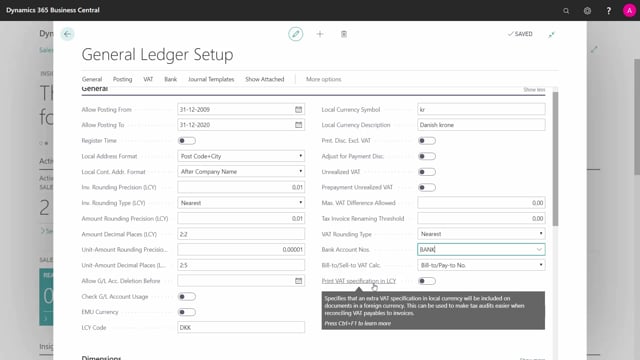


The General Ledger Setup in Business Central holds the core parameters that control how your financial postings behave. You define the allowed posting period, currency settings, rounding rules, VAT handling, and payment tolerances here.
You set the allowed posting period with the “Allowed Posting From” and “Allowed Posting To” fields. These define the date interval where financial postings are permitted. You can also control this per user in the User Setup table.
You define your local currency in the General Ledger Setup, including the currency code, the symbol, and the description. This is the currency your company reports in.
You control VAT behaviour through the VAT rounding type, the maximum VAT difference allowed, and the tax invoice threshold. If an invoice exceeds the tax invoice threshold amount, Business Central can change its name to a tax invoice.
You set payment tolerances in the application section. The tolerance determines how large a difference you accept when closing open entries during payment application.
Where to find the general ledger parameters
The General Ledger Setup is where all your parameters for the general ledger live. Below is a walkthrough of the most basic and most important fields.
Allowed posting period and user time tracking
The first fields to know are the “Allowed Posting From” and “Allowed Posting To” fields. They define the interval where it is allowed to make financial postings. You can also determine this per user in the User Setup table.
In the User Setup, you can define whether you want to measure the time each user actually spends in the system.
Address formats and rounding settings
You can define the local formats for addresses and contact addresses, choosing how you want those laid out from the available selections.
You can set up all kinds of rounding here, including inventory rounding. You decide the precision and whether the rounding goes to nearest, up, or down. You also set the amount rounding precision for local currency and the number of decimal places.
If you hover the mouse over each field, the description explains where it is actually used. As a rule, if you want two-character rounding you set it up one way, and if you want five-character rounding you set it up another way. The decimal places field controls the default number of decimals shown to the user.
Local currency setup
You set up the local currency code, which is the currency your company is defined in. You also set the symbol for that currency and a description for it.
Payment discounts and VAT handling
You can set up standard parameters for payment discounts, including whether you allow payment discounts to be adjusted.
You decide what to do with the unrealised VAT that is calculated, and you can set up a maximum difference allowed on the VAT.
In the tax invoice remaining threshold field, you define whether an invoice should change its name to a tax invoice if it exceeds a given amount.
The VAT rounding type defines whether VAT is rounded up, down, or to the nearest amount.
You can also set up the number series for bank accounts.
VAT specification currency on documents
With a checkmark, you can decide whether the VAT specification on documents is posted in local currency. If you leave it unchecked, it is posted in the receiver’s currency.
Dimensions tab
On the dimensions tab you can see the two global dimensions, but you do not define them here. There is a separate menu for that, and you can find dedicated material on dimensions explaining how to define which of your dimensions become the two global dimensions.
Reporting and account schedules
In the reporting section, you can set up parameters if you use account schedules in Business Central for reporting.
Application and payment tolerances
In the application section, you set up how application works when you receive payments or pay your vendors. You can set up rules for that.
You also define how the tolerances should be on those payments, and how much tolerance you will accept in order to close the open entries.
These are the most important fields in the General Ledger Setup.
Q&A
Where do you define the allowed posting period in Business Central?
You define the allowed posting period in the General Ledger Setup using the “Allowed Posting From” and “Allowed Posting To” fields. You can also set it per user in the User Setup table.
Where do you set the local currency in Business Central?
You set the local currency code, its symbol, and its description in the General Ledger Setup. This is the currency your company reports in.
What does the tax invoice threshold do?
The tax invoice remaining threshold defines whether an invoice changes its name to a tax invoice when it exceeds a given amount.
How does the VAT rounding type work?
The VAT rounding type controls whether VAT is rounded up, down, or to the nearest amount.
Can you post the VAT specification on documents in local currency?
Yes. With a checkmark in the General Ledger Setup, you can post the VAT specification in local currency. If you leave it unchecked, it is posted in the receiver’s currency.
Where do you define the two global dimensions?
You can see the two global dimensions on the dimensions tab in the General Ledger Setup, but you do not define them there. There is a separate menu for assigning which of your dimensions become the two global dimensions.
What are payment tolerances used for?
Payment tolerances determine how large a difference you accept when closing open entries during payment application. You set them in the application section of the General Ledger Setup.