


Microsoft has built an add-on for OIOUBL invoicing in Business Central, so you can send electronic invoices directly from the system. You download the app onto your Business Central solution, set up the right fields on the customer card, and then post and send invoices as XML files that match the OIOUBL format. You can either generate the electronic invoice as part of the post-and-send process, or split the two steps and create the electronic invoice afterwards from the posted sales invoice. The output is an XML file you upload to your electronic invoicing provider.
Electronic invoicing in Business Central with the OIOUBL add-on
Microsoft has made an add-on for OIOUBL invoicing, which is electronic invoicing. Once you download the app onto your Business Central solution, you can send electronic invoices through the OIOUBL format. This article walks through how it works in everyday use. The more detailed setup is covered separately.
Setting up the customer card for electronic invoicing
Before you can send an electronic invoice, you need to make sure the customer card has the right information in place. On the general part of the customer card, set up:
- Contact name
- Email address
- Contact region code
On the invoicing tab, you also need:
- VAT registration number
- GLN number
- Account code
- Profile code, which is part of the OIOUBL setup
Posting and sending an electronic invoice
Once the customer is set up, you can create a document. In this example, a sales invoice is created for the customer directly from the customer card. After selecting a G/L account, a quantity, and a unit price, you post the invoice using Post and Send.
The OIOUBL setup is applied as part of the document profile sending process. When you post, Business Central works on the document and then creates two files in your download folder: a PDF file, because the setup uses PDF, and the XML file that matches the OIOUBL setup you have defined.
Splitting the posting and the file export
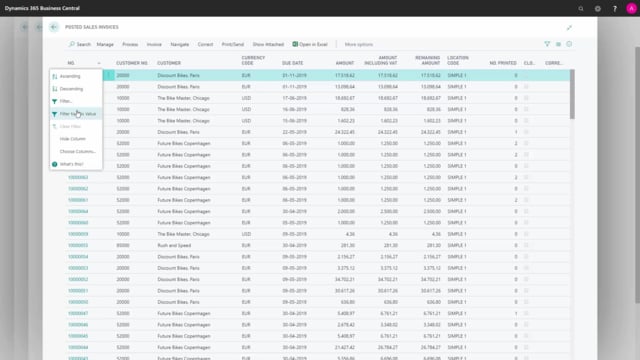
Post and Send is one way of handling it. You can also split the post-and-send process from the file export process. To do this, find the posted sales invoice you just made. From the actions menu, you choose to create an electronic invoice.
This does the same thing, just without the PDF and without sending. It creates the XML file, which you can open in a tool like Notepad. From there, you upload the XML file to your provider of electronic invoices.
Q&A
What do I need to start sending electronic invoices in Business Central?
You download Microsoft’s OIOUBL invoicing add-on onto your Business Central solution. Then you set up the required fields on the customer card, including contact name, email address, contact region code, VAT registration number, GLN number, account code, and profile code.
What files does Business Central create when I post and send an OIOUBL invoice?
It creates a PDF file and an XML file in your download folder. The PDF appears because the setup uses PDF, and the XML file matches the OIOUBL setup you have defined.
Can I generate the electronic invoice separately from posting?
Yes. You can split the post-and-send process from the file export. Find the posted sales invoice, go to the actions menu, and choose to create an electronic invoice. This generates the XML file without the PDF and without sending.
What do I do with the XML file once it is created?
You upload the XML file to your provider of electronic invoices. You can open it in a tool like Notepad first if you want to check it.