


Paying vendors in Business Central is a two-step process. First you register the payment in the bank, then you post the payment in Business Central so your vendor ledger entries are settled. This article walks through how to use the payment journal and the Suggest Vendor Payments function to pay outstanding amounts to a specific vendor.
You start in the payment journal and use Suggest Vendor Payments to let Business Central generate the payment lines for you. You can filter on a single vendor, set an end date so only entries due within that period are included, and set an available amount if your account only has a limited balance to pay with. If you enter zero as the available amount, Business Central ignores the limit and suggests all relevant payments.
When you post the payment, the vendor ledger entries are closed and the remaining amount becomes zero. The Open field on the entries is no longer checked, which confirms the vendor is fully settled.
Opening the payment journal and suggesting vendor payments
From the main menu, search for the payment journal. This is the journal you use for payments. Inside it, you have a function called Suggest Vendor Payments, which finds the entries that need to be paid and creates the lines for you.
In this example, the goal is to pay one specific vendor that has more than one vendor ledger entry. Instead of entering the lines by hand, you let Business Central suggest what to pay.
Setting the criteria for Suggest Vendor Payments
Before running the suggestion, you set a few parameters:
- End date: the cut-off date for which entries to include. If you only want to pay your outstanding entries, they need to fall within that date.
- Available amount: the amount you have in your account to pay with. If you only have a specific amount available, enter it here and Business Central limits the suggestion accordingly. If you enter zero, this is ignored and all relevant entries are suggested.
- Posting date: the date the payment will be posted.
- Starting document number: you have to add this manually. Each payment gets a new number that counts up from the one you enter.
- Bank account: select the bank account that matches the currency you use for that vendor.
To pay only one vendor, filter on that vendor’s number so the function suggests payments for that vendor alone. When you run the suggestion, Business Central tells you it only makes suggestions in the relevant currency, in this case Euro, which is correct for this vendor.
Reviewing the suggested payment line
Business Central creates a line that suggests paying the vendor a total amount. This amount is the combination of the different entries you owe that vendor.
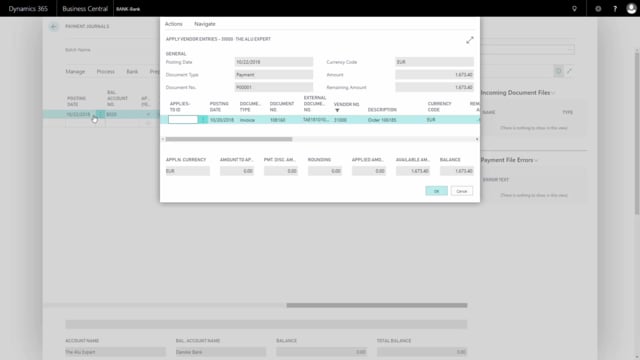
If you look at the line in detail, you can see that it applies to a specific invoice and shows the invoice document number. This is filled in automatically because there was only one invoice to apply to.
If there had been more than one invoice, you could apply the entries manually. Go to Actions, Functions, Apply Entries, and choose the different payments or invoices for that vendor. This lets you gather several entries into one line when you want to fill in the line manually.
Posting the payment after the bank transfer
Once the line is ready, you can post the payment. The normal workflow is to leave the line in the journal first, make the actual payment in the bank, and post the journal afterwards when the payment has gone through. This keeps your Business Central records aligned with what actually happened in the bank.
Assuming the payment has cleared, you post the journal. After posting, the vendor ledger entry should have a remaining amount of zero.
Confirming the vendor is settled
To verify, find your vendor and navigate into the ledger entries. The remaining amount should be zero and the entries should all be closed. The Open field is no longer checked, which confirms you are done with that vendor.
Q&A
How do you pay outstanding vendor amounts in Business Central?
Open the payment journal, run the Suggest Vendor Payments function to generate the payment lines, make the actual payment in the bank, and then post the journal once the payment has gone through. Posting closes the vendor ledger entries.
What does the Suggest Vendor Payments function do?
It finds the vendor entries that need to be paid and creates payment lines for you automatically, based on the criteria you set such as end date, available amount, posting date and bank account. You can filter on a single vendor to pay only that vendor.
What happens if you enter zero as the available amount?
Business Central ignores the available amount limit and suggests all relevant payments instead of restricting the suggestion to a specific balance.
Do you need to set a document number manually?
Yes. You add a starting document number manually, and each payment gets a new number that counts up from there.
How do you apply a payment to multiple invoices for the same vendor?
Go to Actions, Functions, Apply Entries, and choose the different invoices or payments for that vendor. This lets you gather several entries into a single payment line. If there is only one invoice, it is applied automatically.
How do you confirm a vendor is fully paid?
Open the vendor and navigate into the ledger entries. The remaining amount should be zero and the entries should be closed. The Open field is no longer checked when the vendor is fully settled.
When should you post the payment journal?
Leave the line in the journal, make the payment in the bank first, and post the journal afterwards once the payment has gone through. This keeps your Business Central records aligned with the actual bank transaction.