


If you work with foreign currencies in Business Central, you need to understand the difference between updating exchange rates and adjusting exchange rates. Updating exchange rates means changing the rate values in the system, either manually or automatically through an exchange rate service. Adjusting exchange rates means running a batch job that recalculates the value of your currency postings and posts the gains and losses to your general ledger.
Updating an exchange rate has no impact on your general ledger on its own. The impact only happens when you run the Adjust Exchange Rates batch job afterwards.
Each currency in Business Central has two exchange rate values. The relational exchange rate amount is used for all postings and converts amounts into your local currency in the general ledger. The relational adjustment exchange rate amount is used only when you run the exchange rate adjustment batch job, and it affects only your gain and loss accounts.
The difference between exchange rate update and exchange rate adjustment
There’s a clear distinction between the two concepts. The exchange rate update is when you change the actual rates in the ERP system. This is the data you later use when you run the adjustment batch job. The adjustment itself is a separate process that calculates the changes caused by the new rates and posts them to your accounts.
The important point: updating a rate does not touch your general ledger. The figures only move once you run the Adjust Exchange Rates job.
How currencies relate to your local currency
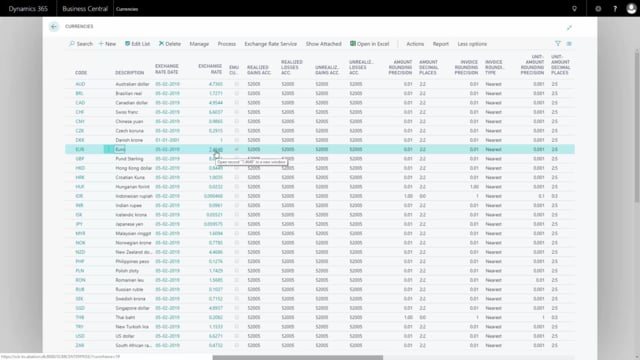
When you open the Currencies list, you see each currency set up in the system, and they all relate to the local currency. In this example, the local currency is Danish Kroner (DKK). For instance, the Euro is set up as a related currency with an exchange rate of 7.4648, which is defined directly on the currency.
Updating an exchange rate manually
To update a rate manually, go from the currency into Exchange Rates. Here you see all the exchange rates registered on different dates. In this example, the only rate so far was created back in February.
To add a new rate, pick a date, for example the first of April, and define the exchange rate for the Euro. You enter the relational exchange rate amount, for example 750, and the adjustment exchange rate amount, which you can set to the same value of 750 or to something different such as 752.
The two exchange rate amounts and what they do
The relational exchange rate amount is used on all postings in the ERP system. When you post journal lines, documents, or anything else, this is the rate that converts your amounts into the local currency that the general ledger reflects. It affects all your revenues and costs.
The relational adjustment exchange rate amount is used only when you do exchange rate adjustments. When you run the exchange rate batch job to calculate the changes caused by your rates, this is the rate that gets used. In the chart of accounts it affects only your gain and loss accounts.
You can set up a difference between the two amounts, but normally you wouldn’t. In most cases you set them to the same value.
Updating exchange rates automatically with an exchange rate service
Instead of entering rates by hand, you can update them automatically if you have an exchange rate service installed and enabled. With the service set up, you go into Exchange Rate Services and click Update Exchange Rates. The service then pulls the rates from the web and updates all your currencies automatically.
This automatic update behaves exactly like the manual update. It only prepares the rate data. It has no impact on your general ledger as long as you haven’t run the Adjust Exchange Rates job.
Q&A
What is the difference between updating exchange rates and adjusting exchange rates in Business Central?
Updating exchange rates means changing the rate values in the system, either manually or through an exchange rate service. Adjusting exchange rates means running a batch job that recalculates the value of your currency postings and posts the resulting gains and losses to your general ledger.
Does updating an exchange rate affect the general ledger?
No. Updating a rate only changes the rate data. The general ledger is only affected when you run the Adjust Exchange Rates batch job.
What is the difference between the relational exchange rate amount and the relational adjustment exchange rate amount?
The relational exchange rate amount is used on all postings and converts amounts into the local currency in the general ledger, affecting revenues and costs. The relational adjustment exchange rate amount is used only when you run the exchange rate adjustment batch job, and it affects only the gain and loss accounts.
Should the relational exchange rate amount and the adjustment amount be the same?
Normally yes. You can set up a difference between the two, but in most cases you give them the same value.
How do you update exchange rates automatically?
If you have an exchange rate service installed and enabled, go into Exchange Rate Services and click Update Exchange Rates. The service pulls the rates from the web and updates all your currencies automatically, without affecting the general ledger.