
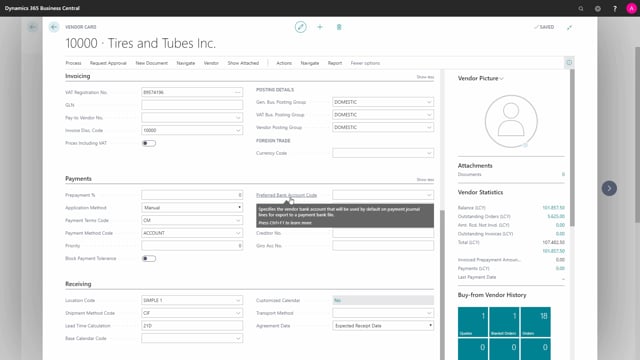


The vendor card in Microsoft Dynamics 365 Business Central holds the financial settings that control how you invoice and pay a vendor. The fields you need from a finance perspective are found under the Invoicing and Payment FastTabs.
The VAT Registration No. field stores the vendor’s VAT number and includes a validation that checks the format against the vendor’s country. The GLN identifies the vendor’s electronic document receiving point, for example a government department.
The posting groups (General Business Posting Group, VAT Business Posting Group, and Vendor Posting Group) work together to control which general ledger accounts the entries are posted to.
The Application Method controls how payments are applied. Most people choose Manual instead of Apply to Oldest because it gives a better overview. Payment Terms control the due date, the Payment Method Code controls how you pay the vendor, and Payment Tolerance settings are configured in the General Ledger Setup, not on the vendor card.
VAT registration number and validation on the vendor card
The first field that matters for finance is the VAT Registration No. This is simply the vendor’s VAT registration number.
Underneath it there is a validation that checks whether you have the right format for the country the vendor is in. This helps you avoid entering a number that doesn’t match the vendor’s country.
GLN for electronic document receiving
The GLN specifies the vendor’s connection for receiving electronic documents. This could be a government department or a similar entity that needs documents delivered electronically.
Posting groups control where entries land in the general ledger
The vendor card includes three posting groups: the General Business Posting Group, the VAT Business Posting Group, and the Vendor Posting Group.
These posting groups are combined to tell the system where on the general ledger the relevant entries should be inserted. If you want to understand how these work in detail, that is a topic in its own right.
Application method for applying vendor payments
The Application Method specifies how payments are applied for the vendor. You have two options:
- Manual – you apply payments yourself
- Apply to Oldest – payments are applied automatically to the oldest open entries
Normally people use Manual because it gives a better overview of what is being paid.
Payment terms and payment method code
The Payment Terms field defines the terms for the due date. In a typical case it could be set to Current Month, and the value looks into an underlying table that defines the calculation.
The Payment Method Code controls how you make the payment to the vendor. This tells you whether the payment goes through the bank, as a transfer, in cash, or by another method.
Block payment tolerance for a vendor
Payment tolerance specifies whether there is any tolerance for the vendor when paying. The tolerance itself is configured in the General Ledger Setup, where you set how large an amount is acceptable when a vendor pays. With a tolerance in place, the vendor doesn’t have to pay the full amount on the invoice or credit memo for the entry to be considered settled.
The Block Payment Tolerance field on the vendor card lets you stop that behaviour for a specific vendor. If you want to block a vendor from having this tolerance, you mark this field. Remember that the tolerance amounts themselves are set up elsewhere in the system, in the General Ledger Setup.
Preferred bank account for paying the vendor
The Preferred Bank Account field tells you which bank account this vendor normally uses, in other words where you pay the money to.
A vendor can have several bank accounts, and you can look up the individual bank accounts when you open the lookup on this field.
Q&A
Where do you find the financial fields on the vendor card in Business Central?
The fields relevant for finance are located under the Invoicing and Payment FastTabs on the vendor card.
What does the VAT registration number validation do?
It checks that the VAT number you enter has the correct format for the country the vendor is registered in.
What is the GLN field used for?
The GLN identifies the vendor’s electronic document receiving point, for example a government department.
Which posting groups are on the vendor card and what do they do?
The General Business Posting Group, VAT Business Posting Group, and Vendor Posting Group are combined to control which general ledger accounts the entries are posted to.
Should you use Manual or Apply to Oldest as the application method?
Most people use Manual because it gives a better overview of which payments are being applied. Apply to Oldest applies payments automatically to the oldest entries.
How do you block payment tolerance for a vendor?
Mark the Block Payment Tolerance field on the vendor card. The tolerance amounts themselves are configured in the General Ledger Setup, not on the vendor card.
Can a vendor have more than one bank account?
Yes. A vendor can have several bank accounts, and the Preferred Bank Account field tells you which one is normally used for payments. You can look up the individual accounts from this field.