


If you receive complaints or returned goods from a customer, you often need to create a sales credit memo in Business Central. This article walks through how to do that correctly, so the credit memo links back to the original posted sales invoice and so your inventory is updated when the item comes back.
The recommended way to create a sales credit memo is to copy the posted sales invoice rather than entering the lines manually. This keeps the pricing exactly as it was on the original invoice and creates the link to the posted document.
When you post the credit memo, Business Central creates both financial entries (G/L entries and VAT entries) and a posted return receipt with an item ledger entry, because the item is added back to your inventory.
You can edit the copied lines before posting, for example to remove a service line or a software update line that you do not want to credit.
Creating a sales credit memo in Business Central
Say a customer sends an item back and you need to credit them. You start by creating a new sales credit memo directly from the menu, pointing it at the customer you sold the goods to, for example customer number 30,000.
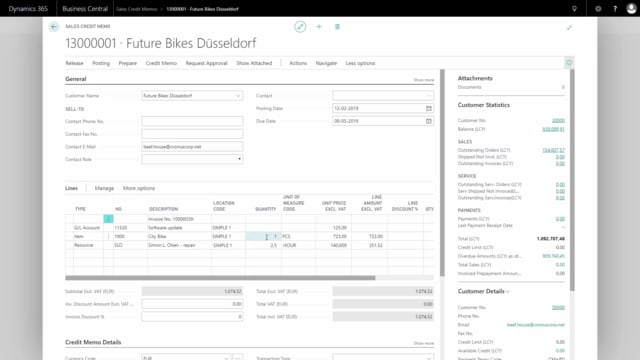
The normal way to prepare the credit memo is to copy the posted sales invoice. You can copy other document types too, but if you want the pricing to be completely correct, choose the invoice whenever possible. That way the prices come through exactly as they were when the invoice was created.
In the copy document window, you select the posted invoice and pick the document number. The list filters on the customer name you have entered. If you are not sure which invoice it is, sort the posted invoices in descending order to find the last one posted.
The copy window also lets you recalculate lines, but the default is not to do that. You normally want the prices to come back exactly as they were originally, so leave recalculation off.
Editing the lines before posting
After copying the invoice into the credit memo, you can change the lines. In a typical example, you might take one bike back, but agree with the customer that a service line should not be credited because the service was done on something else. In that case you simply delete the service line.
The same applies to a software update line that refers to something else. You delete that line as well, leaving only what you actually want to credit.
Why copying the invoice matters instead of entering lines manually
The reason to copy the document rather than just typing in the lines is to keep the connection to the posted sales invoice where the item was originally created.
You could enter a sales credit memo manually with the customer number and the lines, but then it would not be linked to the original posted sales invoice. The link is what gives you traceability back to where the sale came from.
What happens when you post the credit memo
When you are done, you can preview the postings, check the statistics, and then post the credit memo. After posting, Business Central offers to open the posted credit memo so you can check that everything is correct. That is standard functionality.
The posted sales credit memo covers the financial perspective. If you navigate into the entries on the document, you see all the financial entries related to it: G/L entries, VAT entries, and so on.
Inventory and the posted return receipt
Because you actually got the item back, posting the credit memo also creates an item ledger entry through a posted return receipt. Someone in your inventory or warehouse needs a document to handle the returned goods, and that document is the posted return receipt.
If you open the posted return receipt and navigate to its entries, you see an item ledger entry for that specific item. The quantity is positive because the item is added back to inventory, whereas a normal entry of the type sale would be negative in the item ledger entries.
Q&A
How do I create a sales credit memo in Business Central?
Create a new sales credit memo from the menu, select the customer, and copy the posted sales invoice using the copy document function. Then edit any lines you do not want to credit and post the credit memo.
Should I copy the invoice or enter the credit memo lines manually?
Copy the posted sales invoice. This keeps the pricing exactly as it was and links the credit memo to the original posted invoice. Entering lines manually means the credit memo is not linked to the original document.
Why should I not recalculate lines when copying the invoice?
You normally want the prices to come back exactly as they were on the original invoice. The default in the copy window is not to recalculate, so leave it off to preserve the original pricing.
How does Business Central update inventory when an item is returned?
When you post the credit memo, Business Central creates a posted return receipt with an item ledger entry. The quantity is positive because the returned item is added back to your inventory.
Can I remove lines from a copied credit memo before posting?
Yes. After copying the invoice you can delete any lines you do not want to credit, such as a service line or a software update line that relates to something else.