
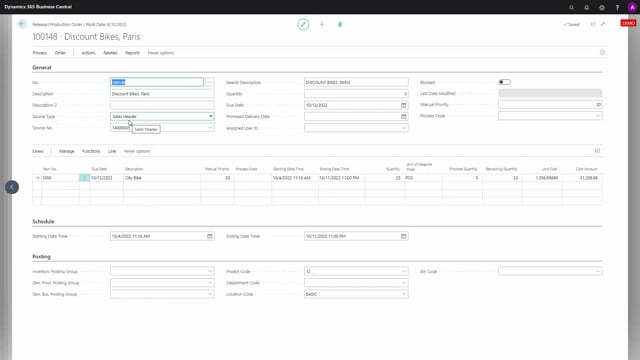


If you create production orders directly from sales orders in Microsoft Dynamics 365 Business Central, you can now see the sales order number and customer name directly on the operation lines in the shop floor overview. Standard Business Central does not expose the sales header information on the routing lines, so you cannot see which customer an operation belongs to when you work at the operation level.
The shop floor overview includes a function that calculates this information when you view the operation lines. You get two extra fields, sales order number and customer name, and you can filter on a specific production order to see only the operations for one customer.
This only works when there is an actual link on the production order back to the sales order, meaning the production order uses the source type sales header.
Sales header information is missing on routing lines in standard Business Central
A common setup is to create production orders with the source type sales header. That means you create the production order directly from the sales order, and the two are linked together in the production order.
The problem is that standard Business Central does not give you access to the sales header information on the routing lines. When you work on the operation level, you cannot see which sales order or which customer the operation relates to. That makes it harder to prioritise work on the shop floor based on the customer behind each order.
See sales order number and customer name on operation lines
The shop floor overview solves this with a function that calculates the sales header information when you view the operation lines. When you update your operations and open the list view, you get two extra fields when you scroll right:
- Sales order number
- Customer name
For each operation tied to a production order that is linked to a sales order, you can now read the sales order number and the customer name directly in the list. You no longer have to leave the operation level to find out who the work is for.
Filter operations by production order and customer
You can also filter on a specific production order to see only the operations for one customer. That gives you a focused view of everything you need to produce for a single customer order, which is useful when you plan and prioritise work on the shop floor.
Keep in mind that this only works when there is a link on the production order to the sales order. If the production order is not created from a sales order, there is no sales header to show.
Q&A
Why can’t I see the customer name on operation lines in standard Business Central?
Standard Business Central does not expose the sales header information on the routing lines. Even if your production order is created from a sales order, you cannot see the sales order number or customer name when you work at the operation level.
What is the source type sales header on a production order?
It means the production order is created directly from a sales order and the two are linked. This link is what makes it possible to pull the sales order number and customer name through to the operation lines in the shop floor overview.
How do I see the sales order number and customer name on operations?
Open the shop floor overview, update your operations and open the list view. Scroll right to find the sales order number and customer name fields. The function calculates this information automatically for operations linked to a sales order.
Can I filter operations to see only one customer’s work?
Yes. You can filter on a specific production order to see only the operations for that customer, which gives you a focused view for planning and prioritising production.
Does this work for all production orders?
No. It only works when there is a link on the production order to a sales order, meaning the production order uses the source type sales header. Production orders not created from a sales order have no sales header information to show.