
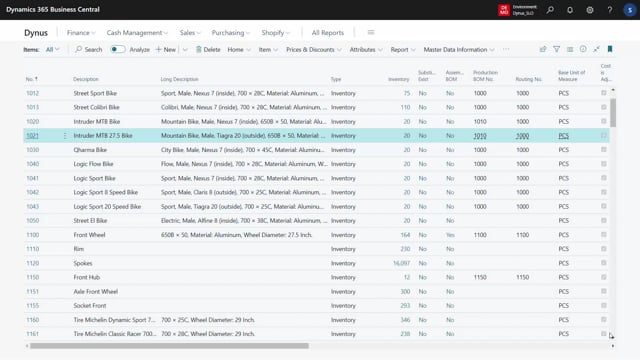


The search functionality in Business Central lets you find items, customers, or vendors using master data parameters, even when no record matches every criterion. You define which criteria are “need to have” and which are “nice to have,” and the search returns results ranked by how many criteria they match.
You can sort results by the number of mismatches, so the closest matches appear first. For each result, you can open the mismatch view to see exactly where the item differs from your search criteria.
This is useful when you search for configurable items with many master data parameters and need to find the item that best fits a customer’s requirements or works best for manufacturing.
How the search with need-to-have and nice-to-have criteria works
When you search on master data for items, customers, or vendors, you can set criteria on the search line and mark each one as either a “need to have” or a “nice to have.” The search then shows you the mismatches directly, so you can see how close each result is to what you asked for.
In a practical example, you might set gender to male as a need-to-have criterion. The bike type can be a nice-to-have criterion. For the wheel diameter parameter, you set the value filter to between 28 and 30.
Running the search returns the matching records. In this case, the search found 14 items.
Sorting and viewing the best matches
You can sort the results by the number of mismatches in descending order, so the items with the most matches appear at the top. You can also close the search criteria window to get a better overview of the results.
In the example, the Intruder mountain bike is the item with the most matches across all the criteria. From there, you can either open the item directly or show the mismatches.
The mismatch view tells you exactly where the item differs from your search. For instance, the search asked for a bike type that was a city bike, flow bike, or sports bike, but the result was a mountain bike. The search asked for seven gears, but the item had 20 gears. The wheel diameter filter was 28 to 30, but the item found was 27.5. The view lists every mismatch this way.
When to use this search approach
This search is particularly helpful when you look for specific items that are configurable and carry many master data parameters. If you build complex products and need to find the item that works best for manufacturing or producing a given item, this gives you a clear way to find the best fit.
It is a way of viewing the items that match your requirements most closely, even when no single item ticks every box.
Q&A
What is the difference between a need-to-have and a nice-to-have criterion in the search?
A need-to-have criterion is a requirement you want the result to meet, while a nice-to-have criterion is optional. The search returns results even when they do not match every criterion, and it shows you which criteria each result misses.
How do I find the item that best matches my search criteria?
Sort the search results by the number of mismatches in descending order. The item with the most matches and fewest mismatches appears at the top of the list.
Can I see where a result differs from my search criteria?
Yes. Open the mismatch view on a result to see exactly which criteria it does not meet, such as a different bike type, a different number of gears, or a wheel diameter outside your filter range.
When is this search functionality most useful?
It is most useful when you search for configurable items with many master data parameters, for example when you need to find the item that best fits a customer’s requirements or works best for manufacturing.