
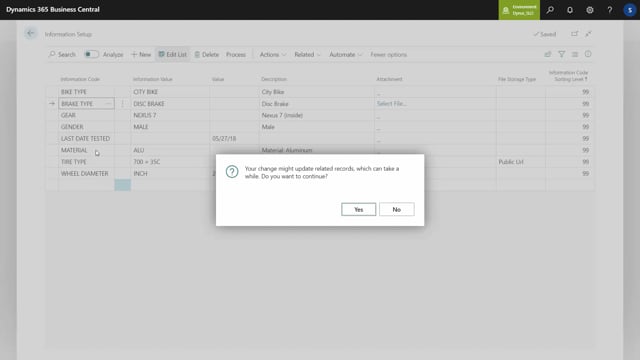


Information codes and information values in Business Central let you build structured dropdown lists for specification data on your items and other entities. An information code works as a category, and the information values are the predefined options that belong to it. You define one information code, then attach as many information values to it as you need.
You can create information values directly in the setup, or build them on the fly from the item list, customer list, or wherever you apply the information code.
You can sort information values in a custom order instead of the default alphanumeric sorting. This is useful for values like clothing sizes, where you want extra small first and extra large further down, rather than sorting them alphabetically.
What information codes and information values are in Business Central
An information value works as a lookup list tied to an information code. Once you have created an information code, you can define as many information values for that code as you want. You then apply these to the specification text and files for all your base items, or any other base entities in Business Central.
Think of the information code as the field or category, and the information values as the available choices for that field.
Building a dropdown list with information values
Here is a practical example using a disc brake. Start by creating an information code, for instance one called “brake type.” Then go into the information values for that code and define the options you want in the dropdown list.
In this case you might create two values:
- Disc brake
- Roller brake
You can add as many information values as you need. When you then enter an item and fill in its specification, the “brake type” field gives you a drill-down list with disc brake and roller brake to choose from. You can also add another value directly while you are working in the item, without going back to the setup.
Creating information values from different lists
You are not limited to building information values in one place. You can create them directly in the information code setup, or you can build them from the item list, the customer list, or wherever you are applying the information code. This means you can add a new value at the point where you actually need it.
Sorting information values in a custom order
By default, values sort in alphanumeric order, which does not always make sense to the user. You can override this with a custom sorting order.
Sorting works on two levels:
- The information code level, where you can set the order in which the codes appear.
- The information value level, where you can set the order of the individual values within a code.
A good example is clothing sizes. With an information code for size, you can sort so that extra small comes first and extra large appears further down, instead of having the values jumbled by alphabetical order. This lets you present the options in the way the user actually understands them.
Q&A
What is the difference between an information code and an information value in Business Central?
An information code is the category or field, such as “brake type” or “size.” An information value is one of the predefined options that belongs to that code, such as “disc brake,” “roller brake,” or “extra small.” You define one information code and attach as many information values to it as you need.
Where can I create information values?
You can create information values directly in the information code setup, or you can build them from the item list, the customer list, or wherever you are applying the information code. You can even add a new value while filling in an item’s specification.
Can I control the order in which information values appear in a dropdown?
Yes. You can define a custom sorting order on both the information code level and the information value level. This lets you sort values in a logical order instead of the default alphanumeric order. For example, you can have clothing sizes run from extra small to extra large rather than sorting alphabetically.