
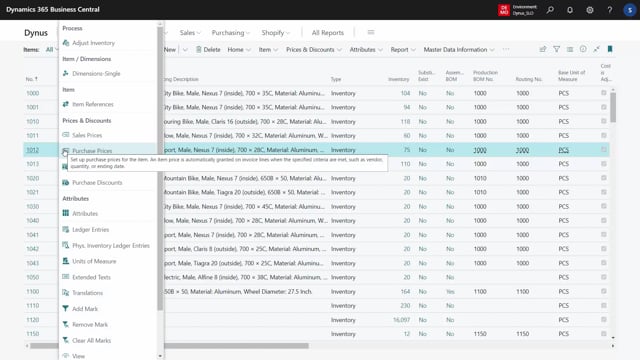


With master data information in Business Central, you can search for and mark items, customers, and vendors, and then filter on those markings everywhere in the system. The marking is stored in a field called Marked by User, which exists on the item, customer, and vendor tables. This lets you build a custom list of records, reuse it across different parts of Business Central, and import it into the information matrix for maintenance work.
You can mark records one at a time, select several at once, or use the search functionality to find and mark large groups based on master data criteria. The markings stay in place until you clear them, so you can work with the same list for as long as you need.
Marking items, customers, and vendors
The simplest way to mark a record is to click the small lookup dots on an item and select Add Mark. When you add a mark, the system creates a filter using the Marked by User field. You can add marks to several items at once by selecting multiple records and adding marks to all of them in one go.
Removing marks works the same way. You can remove a single mark, the highlighted marks, or clear all marks at once.
Using search to mark large groups of records
Instead of marking records one by one, you can use the search functionality to find many items based on master data and mark them together. You can also use a template to drive the search.
As an example, you can search for all your bikes that are male bikes. You can then add a criterion that the bike must be a seven-gear model. In this scenario, that returns nine bikes that are seven-gear male bikes. You select those and add them to the mark list. The mark list now contains what you marked before plus the seven-gear male bikes.
How the Marked by User field works
The filter uses a field called Marked by User. The field value contains your user ID with an asterisk added in front and at the end, which means other users can use the field as well, each with their own marks.
Because the Marked by User field exists on the item, customer, and vendor tables, you can filter on your list of marked records everywhere in Business Central. This means you can build a large list of marked records and reuse it across the system.
Importing marked records into the information matrix
One use of the marked records is to import them into the information matrix. If you want to work with a specific set of items for maintenance purposes, you can import directly from your Marked by User field.
To do this, import the lines and add your user ID. The system then adds the records you just marked. It remembers the markings until you change them. If you work with the same items for a full week, it keeps the marking until you clear all marks or add or remove records from the list. When you clear all of them, the list is emptied.
Q&A
How do you mark an item in Business Central?
Click the small lookup dots on the item and select Add Mark. The system creates a filter on the Marked by User field. You can also select several items at once and add marks to all of them in one go.
Can you mark many records at the same time?
Yes. Use the search functionality to find records based on master data criteria, for example all seven-gear male bikes, then select them and add them to the mark list.
What is the Marked by User field?
It is a field that stores your markings. The value contains your user ID with an asterisk in front and at the end, so each user can keep their own separate set of marks. The field exists on the item, customer, and vendor tables.
Can other users see and use my markings?
The Marked by User field is shared, but because each user’s marks are stored against their own user ID, multiple users can use the field at the same time with their own markings.
How long do the markings stay in place?
The markings remain until you change them. You can work with the same list for as long as you need. They stay until you clear all marks or add or remove records from the list.
How do you use marked records in the information matrix?
Import directly from your Marked by User field into the information matrix and add your user ID. The system adds the records you marked, which is useful when you want to work on a specific set of items for maintenance.