
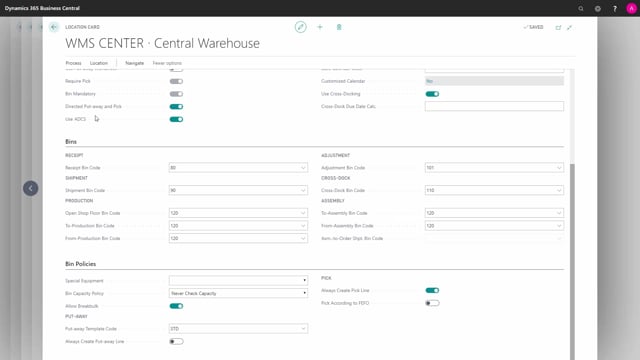


In Microsoft Dynamics 365 Business Central advanced warehousing, you control whether break bulk is allowed on a location through the Allow Breakbulk setting in the bin policies on the location card.
When you allow break bulk, a warehouse pick automatically splits a larger unit of measure into smaller ones. For example, it breaks a box down into pieces, and the pick creates separate break bulk lines for the split.
When you disable Allow Breakbulk, the pick will not split the box. Instead, it creates fewer lines and leaves the bin code empty on the line where the item is not available in the requested unit of measure. This empty bin code is your signal that someone needs to perform the break bulk manually.
How Allow Breakbulk works in directed put-away and pick
If you work with directed put-away and pick, meaning the advanced warehouse setup in Business Central, you can define whether break bulk is permitted. The control sits on the location card under the bin policies, where you set or clear the Allow Breakbulk checkmark.
Break bulk handles the situation where you have stock in one unit of measure but need to pick in a smaller one. A typical case is having only boxes on inventory while a shipment requires individual pieces. With break bulk enabled, the system handles the conversion for you during the pick.
What happens when break bulk is allowed
With the Allow Breakbulk checkmark set on the location card, create a pick from a warehouse shipment as usual. In a scenario where you have no pieces on inventory, only boxes, the pick generates four lines with different units of measure.
When you open the warehouse pick, you see the four lines. The first two are break bulk lines that split the box into pieces. The system knows where to take the box and how to break it down, so the warehouse worker gets clear instructions.
What happens when break bulk is not allowed
Now delete the pick and create it again, this time with the Allow Breakbulk checkmark removed on the location card. Use the same location and the same warehouse shipment, then run Functions and Create Pick exactly as before.
This time the pick creates only two lines, and it does not add a bin code on the first line. Without the bin code, you do not know where to take the item, because the item is not on inventory in pieces. The empty bin code tells you that someone has to do the break bulk manually before the pick can be completed.
What this means for your warehouse setup
The Allow Breakbulk setting decides whether Business Central handles unit-of-measure conversions automatically or leaves them to your warehouse staff. If you keep it enabled, picks run smoothly even when stock is held in larger units. If you disable it, expect picks with missing bin codes that flag manual work, which is useful if you want full control over when and how boxes get split.
Q&A
Where do you enable or disable break bulk in Business Central?
You set the Allow Breakbulk checkmark in the bin policies on the location card. The checkmark controls break bulk for directed put-away and pick locations.
What does a warehouse pick look like when break bulk is allowed?
The pick creates the lines needed to split a larger unit into a smaller one. In the example with only boxes on inventory, the pick generates four lines, where the first two are break bulk lines that split the box into pieces.
How do you know break bulk needs to be done manually?
When Allow Breakbulk is disabled, the pick leaves the bin code empty on the line where the item is not available in the requested unit of measure. The empty bin code signals that someone needs to perform the break bulk manually.
Why would the pick create fewer lines without break bulk?
Without break bulk, the system does not split the box into pieces, so it creates fewer lines. In the example, the pick drops from four lines to two and cannot assign a bin code where pieces are not on inventory.