
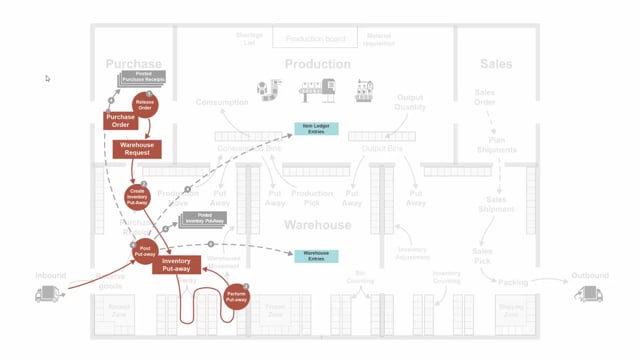


When you set up a location in Business Central with Require Put-away enabled but Require Receive disabled, you handle the entire inbound flow with a single document called the inventory put-away. This document both performs the physical put-away and posts the purchase order in one step.
To start the flow, you release the purchase order. Releasing it creates a warehouse request that waits for a warehouse document. From the purchase order you then create the inventory put-away.
When you post the inventory put-away, the system creates the posted inventory put-away, warehouse entries that move the item into the final bin, item ledger entries, and the posted purchase receipt. You do not need a separate warehouse receipt document.
How the inbound flow works with Require Put-away but not Require Receive
The starting point is the purchase order. If you want to handle the goods with a warehouse document, you first release the purchase order. While releasing it, the system creates a warehouse request that waits for a warehouse document to be created.
The next step is to create an inventory put-away directly from the purchase order. The inventory put-away is a combined document. It handles the put-away and posts the purchase order at the same time.
Printing and registering the put-away list
Once you have the inventory put-away document, you can print a put-away list. With this list you walk around the warehouse and perform the put-away, registering on the list what you actually do.
After the physical work, you update the inventory put-away document with the actual quantities and the bins where you placed the items. Then you post the put-away.
What gets created when you post the inventory put-away
Posting the inventory put-away creates several entries at once:
- A posted inventory put-away
- Warehouse entries, where the item goes directly into the final bin
- Item ledger entries related to the posted purchase receipt, because the document also posts the purchase order
In this scenario, with the Require Bin checkmark and the Require Put-away checkmark set, the inventory put-away document posts all of it in one operation.
Q&A
What does the inventory put-away document do in Business Central?
It is a combined document that performs the put-away and posts the purchase order at the same time. When you post it, you get a posted inventory put-away, warehouse entries, item ledger entries, and a posted purchase receipt.
Why do you release the purchase order before creating a warehouse document?
Releasing the purchase order creates a warehouse request that waits for a warehouse document. Without this request, you cannot create the inventory put-away.
Do you need a separate warehouse receipt with this location setup?
No. When the location has Require Put-away enabled but Require Receive disabled, the inventory put-away handles both the put-away and the posting of the purchase order, so no separate receipt document is needed.
Where do the items go when you post the inventory put-away?
The items go directly into the final bin, and warehouse entries are created to reflect this.