


If you manage inventory in Business Central, you can use counting periods to control how often each item gets counted. Instead of counting everything at once, you assign a frequency to each item and let the system tell you which items are due for counting in the current period.
You set up the counting period on the item card or on the SKU card per location. The frequency decides how often an item is counted. A slow-moving item might be counted once a year, a normal item twice a year, and a fast-moving item six times a year.
When you create a physical inventory order and calculate per counting period, Business Central lists only the items that have not yet been counted in the current period. After you post the count, the system updates the last physical inventory date and calculates the next counting start date based on the frequency. This prevents you from counting the same item more often than necessary.
Setting up the counting period on the item card
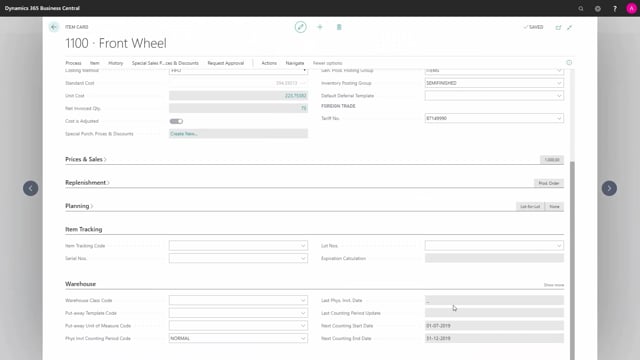
The physical inventory counting period is set up on the item card, or on the stockkeeping unit (SKU) card per location if you count items on different locations. On the counting period, you define the frequency, meaning how often the item should be counted.
In a typical scenario you would split items into groups:
- Slow-moving items counted once a year
- Normal items counted twice a year
- Fast-moving items counted six times a year
On the warehouse tab of the item card you can see the last physical inventory date, the last counting update, and the next counting period. For an item with a last physical inventory date of 1 January 2020, the next counting period is calculated from that date and the assigned frequency.
If you look at an item that has never been counted, for example item 1100, the warehouse tab shows no last physical date. That tells you the item has not been counted with the counting job yet.
Creating a physical inventory order and calculating per counting period
To count the items that are due, you create a physical inventory counting order. Set the location code, for example Main, and choose to calculate per counting period. This selects the items that have not been counted in the period you are in.
Set the posting date for the count. In this example the posting date is 1 January 2020. When you calculate per period, Business Central produces a list of the items that need to be counted.
An item that has already been counted in the current period, such as item 1500, does not appear on the list. That is exactly the point of the counting period: items that are already up to date are left out, so you avoid unnecessary counts.
Recording the count and posting the order
From the order you create a recording and navigate into it to do the counting. In practice you print the recording document so a warehouse employee can find the item on the bin codes, count it, and update the quantities. You can create several recordings for one physical inventory order, which is useful when different people count different parts of the warehouse.
Fill in the information on the header, finish the recording, and then finish the physical inventory order. When you post the order, the inventory counts are posted. If everything was correct and the counted quantity matched the system, no inventory changes are made.
What happens after posting
After posting, the item card shows an updated last physical inventory date. Business Central also calculates the next counting start date based on the counting period frequency. This lets you control which item was counted when, and it keeps you from counting items that you have already counted in the current period.
Q&A
Where do you set up the physical inventory counting period in Business Central?
You set it up on the item card, or on the SKU card per location if you count items on different locations. On the counting period you define the frequency, meaning how often the item should be counted.
What does calculating per counting period do when you create a physical inventory order?
It selects only the items that have not been counted in the current period. Items that have already been counted in the period are left off the list, so you do not count them again unnecessarily.
What happens to the item card after you post a physical inventory count?
Business Central updates the last physical inventory date and calculates the next counting start date based on the counting period frequency.
Can you have multiple recordings for one physical inventory order?
Yes. You can create many recordings for one inventory order, which lets different warehouse employees count different parts of the inventory before you finish and post the order.
How can you tell if an item has never been counted?
Check the warehouse tab on the item card. If there is no last physical date, the item has not been counted with the counting job yet.