
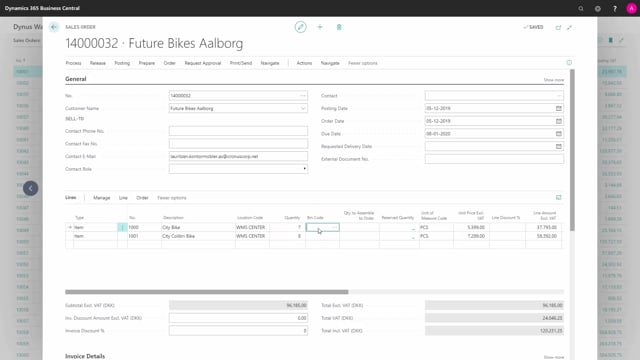


If you run a warehouse in Business Central with the Directed Put-away and Pick option enabled on the location card, the outbound process follows a fixed sequence: create and release a sales order, generate a warehouse shipment, optionally add more sales orders to that shipment, create a warehouse pick, register the pick, and post the shipment. Posting the shipment posts all the sales orders attached to it in one go.
With Directed Put-away and Pick enabled, you cannot see or change the bin code directly on the sales order line. The line only shows that a shipment is required. This differs from a location that uses individual warehouse checkmarks without Directed Put-away and Pick, where the bin code is visible and editable on the sales order line.
On a Directed Put-away and Pick location, the Quantity to Handle is not filled in automatically on the pick lines. You enter it manually for each line, which forces warehouse employees to confirm every activity physically.
You can change bin codes on the pick and split a pick line to pick the same item from several different bins.
The outbound flow with Directed Put-away and Pick
This walkthrough uses a WMS location that has the Directed Put-away and Pick checkmark set on the location card. When that checkmark is active, all the other warehouse handling checkmarks are set by default and cannot be changed. That is the most controlled warehouse setup in Business Central.
The full flow works like this:
- Create a sales order for a customer and add the item numbers and quantities you want to ship.
- Release the sales order.
- Create a warehouse shipment from the sales order.
- Add more sales order documents, or other document types, to the same warehouse shipment.
- Create a warehouse pick.
- Adjust bin codes and split lines on the pick as needed.
- Register the pick.
- Post the warehouse shipment, which posts every sales order attached to it.
The difference in the sales order line
One practical difference shows up on the sales order line. On a main location that has the various warehouse checkmarks but not the Directed Put-away and Pick checkmark, the bin code is displayed on the line, and you can change it and look it up.
With the Pick checkmark, the line only states that shipment is required. You cannot see or change the bin code on the sales order line. The bin handling happens later, on the warehouse pick.
Creating the warehouse shipment and pick
When you create the warehouse shipment from the sales order, it opens automatically. On the shipment you can add more sales order documents, so you can ship for several different customers from one document.
The shipment status is Open after you create it. When you create the warehouse pick, the shipment is released automatically, so you do not have to release it as a separate step.
From there you navigate into the warehouse pick, where all the pick lines are listed.
Changing bins and splitting pick lines
On the pick you can change a bin code directly to select another bin. You can also print the pick so a warehouse employee can carry the document around the warehouse, or you can use a terminal scanner or scanner device instead.
If you take part of a quantity from one bin and the rest from another, you can split the pick line. Splitting creates a new line where you enter the other bin you are picking from. You then fill in the Quantity to Handle on each line.
Why Quantity to Handle is not filled in automatically
On a Directed Put-away and Pick location, the Quantity to Handle is not defaulted on the pick lines. You enter it manually for every line. That is intentional: the whole point of the Pick checkmark or the Directed Put-away and Pick checkmark is to keep the warehouse tightly controlled and have employees confirm each activity they perform.
On a printed pick, the warehouse employee writes in the actual quantity handled, then enters that quantity in Business Central. This tells the system exactly what was done.
Registering the pick and posting the shipment
Once the Quantity to Handle is filled in on all lines, you register the pick. Back on the warehouse shipment, everything now shows as picked, so you can post the shipment.
Posting the shipment also posts all the sales orders attached to it. In this example three sales orders were posted at once: the one being worked on plus two others fetched onto the warehouse shipment. The Shipped Quantity then updates on each sales order, for example to 7 and 8 on one of them.
This is the complete warehouse flow for a Directed Put-away and Pick location. The one thing not covered here is creating the shipment and the picks more intelligently with a pull strategy, which is a separate topic.
Q&A
Can you change the bin code on a sales order line with Directed Put-away and Pick?
No. With Directed Put-away and Pick enabled, the sales order line only shows that a shipment is required. The bin code is not visible or editable on the line. You handle bins later on the warehouse pick. On a location without Directed Put-away and Pick, the bin code is visible and editable on the sales order line.
Why is Quantity to Handle empty on the warehouse pick?
On a Directed Put-away and Pick location, Quantity to Handle is not filled in automatically. You enter it manually for each line so that warehouse employees confirm exactly what they physically picked. This is by design to keep the process controlled.
Do you have to release the warehouse shipment manually?
No. The shipment is created with status Open, and it releases automatically when you create the warehouse pick.
Can one warehouse shipment cover several sales orders?
Yes. You can add more sales order documents, or other document types, to the same warehouse shipment, including orders for different customers. When you post the shipment, all attached sales orders are posted at the same time.
How do you pick the same item from more than one bin?
Split the pick line. Splitting creates a new line where you enter the other bin you are picking from, and you fill in the Quantity to Handle on each line.
What happens to the sales orders when you post the warehouse shipment?
Posting the shipment posts every sales order attached to it. The Shipped Quantity is updated on each sales order line accordingly.