
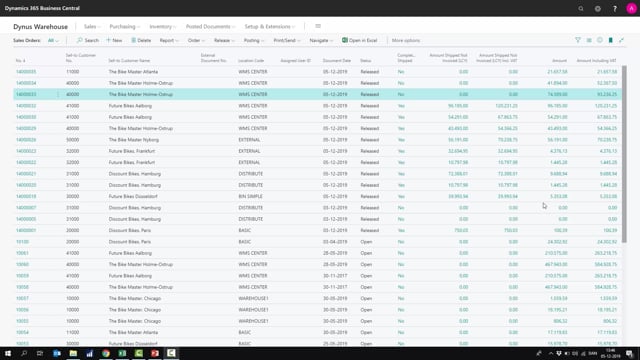


When you create warehouse shipments in Business Central, you can choose between two approaches: a push strategy where the shipment is created directly from the sales order, or a pull strategy where the warehouse creates the shipment manually and pulls in the relevant source documents.
You use the push strategy when the salesperson or the person entering the sales order should create the warehouse shipment directly from the order. You do this from the action menu on the released sales order by selecting Create Warehouse Shipment.
You use the pull strategy when you want your warehouse staff to control which orders enter the warehouse without giving them access to edit the sales orders themselves. You create the warehouse shipment manually and then pull source documents into it using either Get Source Documents or the Use Filters to Get Source Documents function.
With the filter function you can set up reusable filter batches that select released sales orders by criteria such as shipment method code and shipping agent code, so you can repeatedly run the same selection with a single click.
Push Strategy: Creating a Warehouse Shipment Directly from the Sales Order
The push strategy is the simplest way to get a warehouse shipment going. Once you have created and released a sales order, you go to the action menu on the sales order and select Create Warehouse Shipment. The shipment is then pushed straight from the order into the warehouse.
This approach normally fits the salesperson or whoever enters the sales order. They create the order, release it, and push the shipment in one flow.
The trade-off is that you have to do this from the sales order itself. If you would rather keep your warehouse staff out of the sales orders, perhaps because you don’t want them changing things on the order that they shouldn’t touch, then the push strategy puts the action in the wrong hands. In that case the pull strategy is the better fit.
Pull Strategy: Creating the Warehouse Shipment Manually
With the pull strategy, you create the warehouse shipment manually in the Warehouse Shipment window. You open the window, create a new warehouse shipment, and specify the location code. This gives you a prepared warehouse shipment header that is ready to receive lines.
From the header you can pull source lines into the shipment in a few different ways, so your warehouse staff stay in control of what comes into the warehouse without ever opening the sales orders.
Pulling Source Documents into the Warehouse Shipment
The first method is Get Source Documents. You open the function, select which sales orders to include, for example the first and the last one in the list, and press OK. Business Central imports the sales order lines into your warehouse shipment lines. You can run this several times to add more orders.
The second method is Use Filters to Get Source Documents. This is a planning tool where you can set up many different filter batches in advance. If you already have a batch prepared, you simply press run and it imports whatever matches the filter. In a scenario with three released sales orders (33, 34 and 35), running an unfiltered batch pulls in lines from all three.
Using Filters to Control Which Sales Orders Are Imported
The filter setup is where this method becomes powerful. From the process you can open the standard filter you have set up and edit it in the modify window to see and adjust all the filtering it uses.
For example, you might filter on shipment method code so that you only include sales orders shipped free on board. With that filter applied, running the function pulls in only the matching orders, in this example orders 33 and 34 instead of all three.
You can filter on any of the fields available to distinguish between the released sales orders you want to import. The function only ever picks up released sales orders. Change the filter to a shipping agent code instead, and you get a different set of two orders.
You can also combine several filters, which is the normal way to use this. By adding a filter on both shipping agent code and shipment method code, you narrow the selection further. In the example, combining free on board with a specific shipping agent leaves only a single matching sales order.
You save these different filter setups as separate steps, step number 1, step number 2, and so on. Each step holds its own combination of filters, and you can run any of them easily from the list to pull the matching sales orders into your warehouse shipments. This is the pull strategy in action.
Q&A
What is the difference between a push and pull strategy for warehouse shipments?
With a push strategy you create the warehouse shipment directly from the released sales order using the Create Warehouse Shipment action, typically done by the salesperson. With a pull strategy you create the shipment manually in the Warehouse Shipment window and pull source documents into it, keeping control with the warehouse staff.
When should I use the push strategy?
Use the push strategy when the person entering the sales order should also create the warehouse shipment. It runs in one flow: create the order, release it, then push the shipment from the order’s action menu.
When should I use the pull strategy?
Use the pull strategy when you want your warehouse staff to decide which orders enter the warehouse without giving them access to edit the sales orders themselves.
How do I pull sales orders into a warehouse shipment?
You have two options. Get Source Documents lets you manually select which sales orders to include. Use Filters to Get Source Documents lets you run a saved filter batch that automatically imports all matching released sales orders.
Which fields can I filter on when pulling source documents?
You can filter on any of the available fields, including shipment method code and shipping agent code. You can also combine multiple filters and save them as separate reusable steps that you run with a single click. The function only imports released sales orders.