
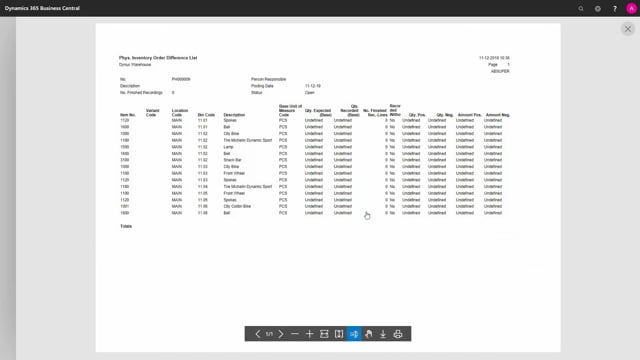


If you run a warehouse in Business Central on a location that uses bins or has bins set to mandatory, you can use physical inventory orders to count stock by rack, shelf, or individual bin. This gives you a structured way to count part of your warehouse without touching the rest.
You filter the count by bin code. For example, you can count every bin that starts with 11 by entering a bin filter, and Business Central includes the entire rack in the count. The same item can exist on other racks without being affected.
This works on locations with bins, but not on locations that use directed put-away and pick. For those advanced warehouse locations you need a different counting method.
You can print the physical inventory order as a counting document, walk the rack, and record the counted quantities per bin, per frame, or per rack.
Using physical inventory orders for bin-based counting
On a location that uses bins, or where bins are mandatory, you can use inventory orders for counting. This does not apply to locations with directed put-away and pick. For everything else with bins, the physical inventory order is a practical tool for counting, for instance per rack, per bin, or per shelf.
The idea is that you do not have to count the whole warehouse at once. You can target a specific area of your inventory and leave the rest untouched, even if the same items appear in other locations.
Counting a complete rack with a bin filter
When you create a new physical inventory order and want to count a complete rack, you start by selecting the location code to count. From the menu you can then choose to count per bin.
Say you want to count everything on a location where the bin codes start with 11. A typical bin code is structured as something like 11.1, 11.2, and so on, where the parts represent the rack, the frame, the bin, and possibly the exact place on the bin.
In this scenario you simply enter a filter for rack number 11. Business Central then calculates everything that sits on that specific rack, so you end up with a document and a recording covering exactly that rack and nothing else.
Printing the counting document and recording the result
Once the order is set up, you can print it. The printed document shows the rack and lists all the bins on it, so you can see that everything belongs to the same rack. This is the complete document you take with you when you go out to count.
From there you make a recording, print the recording, and record the counted quantities. You can do this per bin, per frame, or per rack, depending on how you want to break down the count.
Q&A
Can I use physical inventory orders for counting on a bin-enabled location in Business Central?
Yes. On a location that uses bins or has bins set to mandatory, you can use physical inventory orders to count stock per rack, per bin, or per shelf.
Does bin-based counting with physical inventory orders work on directed put-away and pick locations?
No. This counting method does not work on locations with directed put-away and pick. It applies only to locations with standard bins.
How do I count only one rack without affecting items on other racks?
Select the location code, choose to count per bin, and enter a bin filter for that rack, for example all bin codes starting with 11. Business Central counts everything on that rack only, even if the same items exist on other racks.
How is a bin code structured in this setup?
A bin code is typically built up as rack, frame, bin, and optionally the place on the bin. For example 11.1 or 11.2, where 11 is the rack number.
Can I print the count and record results at different levels?
Yes. You can print the physical inventory order as a counting document and record the counted quantities per bin, per frame, or per rack.