
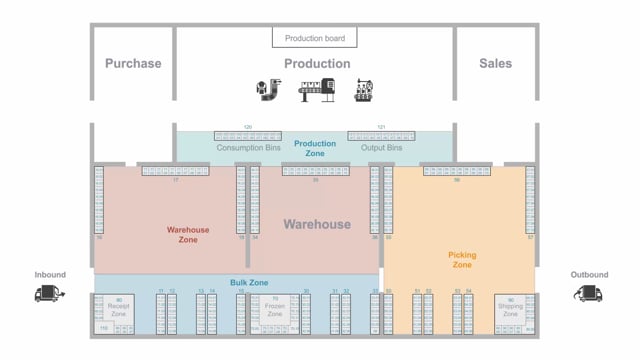


In Microsoft Dynamics 365 Business Central, you can structure your warehouse using three levels: locations, zones, and bins. Locations are the top level, zones sit beneath them, and bins are the most detailed level inside a zone.
Zones only become available when you enable the Directed Put-away and Pick checkmark on the location card. If you do not need zones, you can run the system with just locations and bins.
A location usually represents a physical site, such as a production plant. A bin is the actual physical place in the warehouse where you store an item.
The three levels of warehouse structure in Business Central
Business Central lets you organise your inventory using a hierarchy. At the top you have locations. Within a location you can define zones, and within each zone you can set up bins.
The location is the highest level and normally corresponds to a geographical site. A typical example is your production plant, which would be treated as a single location.
A location can be divided into zones. You might use different zones for different purposes, for example a frozen zone or zones dedicated to specific handling needs.
Each zone can be divided into bins. A bin is the actual place in the inventory where you store your items. Bins help guide your warehouse activities by telling you where to put items when you receive them, where to pick from when you ship, and where to move items when you transfer them into production.
When zones require the Directed Put-away and Pick setting
The middle level, zones, is only available if you set the Directed Put-away and Pick checkmark on the location card. This is the setting that unlocks the full three-level structure of locations, zones, and bins.
With this checkmark enabled you get the complete complexity of warehouse management, including the ability to direct put-away and picking activities through zones and bins.
Running Business Central without zones
You do not have to use all three levels. If you want to avoid the Directed Put-away and Pick checkmark and the zones it brings, you can run the system with only locations and bins.
This gives you a simpler setup where you still control where items are stored at the bin level, but without the extra structure that zones add.
Q&A
What are the three levels of warehouse structure in Business Central?
The three levels are locations, zones, and bins. Locations are the top level and usually represent a geographical site. Zones sit within a location, and bins are the most detailed level inside a zone, representing the actual place where items are stored.
What setting is required to use zones in Business Central?
You need to enable the Directed Put-away and Pick checkmark on the location card. Without this setting, zones are not available.
Can you use Business Central warehouse management without zones?
Yes. If you do not enable the Directed Put-away and Pick checkmark, you can run the system with only locations and bins, skipping the zone level entirely.
What is a bin in Business Central?
A bin is the actual physical place in the inventory where you store your items. Bins help guide where to put items during put-away, where to pick from when shipping, and where to move items when transferring into production.