
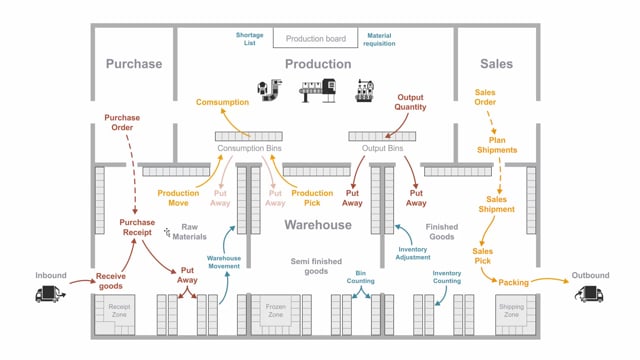


One of the most common challenges in warehouse and production environments is knowing whether an item is actually registered in Business Central. If you walk up to an item in the warehouse and ask whether it has been posted as received or as consumption, you should be able to get a clear answer. The trick is to make stock status physically visible on the floor.
A simple and effective method is to use yellow lines to separate registered items from unregistered items. Everything inside the line is registered in the system. Everything outside the line is not. This applies to both inbound goods at the receiving area and outbound items moving into and out of production.
This approach does not require a new module or a complex setup. It relies on dedicated physical areas and a shared understanding among everyone working in the warehouse and production. The goal is that every employee can tell at a glance whether an item has been posted in Business Central.
Keeping the warehouse and Business Central in sync
The core problem is maintaining alignment between the physical reality on the floor and what the ERP system shows. If goods are physically present but not yet posted, or posted but not yet moved, you lose track of your real inventory. Everyone in the warehouse and production should know whether items are registered in the system or not, and a visual system makes that immediate.
How to use yellow lines for inbound goods
When you receive goods in the receiving area, place them in a received bin that sits outside the yellow line. This signals that the goods have not been handled in the system yet.
Once you count the goods and register them on a purchase receipt or the purchase order, you do the posting or registration and move the goods to the other side of the yellow line. The position of the item now tells anyone walking by that the goods are registered in Business Central.
How to use yellow lines for production and outbound goods
The same principle works on the outbound side and inside production.
When you pick into production, you move the item from the warehouse to the consumption bins. While the item sits in the consumption bins, it is still on inventory. When the production people move it to the other side of the yellow line, they do the posting that records the consumption.
You also need to post the output from production when you put the finished item on the output bins. Until that posting happens, the item should remain on the other side of the yellow line. This keeps the physical location and the system status consistent at every step.
What to do if you cannot draw lines on the floor
Drawing large yellow lines across your floor is not always practical. You do not need them. What matters is having dedicated areas, even small ones, in both the production environment and the warehouse where you can clearly distinguish registered from unregistered items.
A small designated spot where items are either registered or not registered works just as well. The point is that everybody working in the environment should know whether the items are registered in the system or not.
Q&A
What problem does the yellow line method solve in Business Central?
It makes the registration status of items physically visible. Anyone in the warehouse or production can see whether an item has been posted in Business Central as received, consumed, or as output, without having to check the system.
How do the yellow lines work for receiving goods?
When goods arrive, you place them in a received bin outside the yellow line to show they have not been posted yet. Once you register them on a purchase receipt or purchase order, you move them to the other side of the line.
How does the method apply to production?
When you pick into production, you move items to the consumption bins, where they are still on inventory. When production posts the consumption, the items move across the yellow line. Finished output is posted when it reaches the output bins and is moved across the line.
What if I cannot draw yellow lines on my floor?
You do not need actual lines. Use dedicated areas, even small ones, in the warehouse and production to separate registered from unregistered items. The important thing is that everyone can tell the difference.