
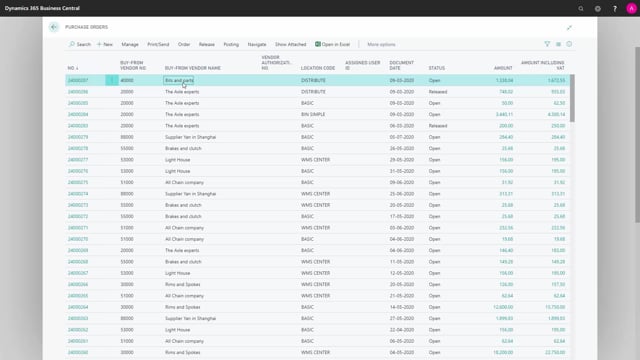


In Business Central you can create inventory put-aways using either a push strategy or a pull strategy. The push strategy means the purchaser creates the put-away directly from the purchase order. The pull strategy means the warehouse staff create it themselves by fetching the released source documents.
In both strategies you must release the purchase document first. Releasing the document signals to the inventory that it is ready to be handled.
With inventory put-aways, each purchase order produces its own put-away document. You get one inventory put-away per purchase order, and you cannot bundle several purchase orders into one document. To bundle multiple purchase orders into a single warehouse document, you must enable the Directed Put-away and Pick checkmark on the location and use the pick warehouse functionality.
Setting up the location for inventory put-aways
The behaviour starts with the location setup. In this example, two purchase orders are created on a location with the code Distribute. On that location there is no checkmark in Warehouse Receipt, but there is a checkmark in Warehouse Put-away. With this combination, the system uses inventory put-aways.
To show the two strategies, the second purchase order is released, but the first one is left unreleased.
Push strategy: the purchaser creates the inventory put-away
With a push strategy, the purchaser works directly from the purchase order. This is the natural place for the purchaser to act, since they already have the order open.
If you try to create the warehouse put-away from a purchase order that has not been released, you get an error. The document has to be released first. This applies in both the push and the pull scenario.
Once the purchase order is released, you go to the actions and choose Create Inventory Put-away. The system creates the inventory put-away document. In this example it created one document for purchase order 287.
You can then search for your inventory put-aways and open the put-away document list. There you find the document created for source number 287, which is the purchase order. You open the inventory put-away and handle it from there.
Pull strategy: the warehouse staff fetch the source documents
The alternative is the pull strategy, where the warehouse staff create the inventory put-away manually. The purchaser only releases the purchase order, and the warehouse people fetch it.
You start by creating a new inventory put-away. The location code is filled in automatically from the Warehouse Employee setup linked to your user. From there you choose Process and then Get Source Documents.
The source documents available here are purchase orders, sales return orders, and inbound transfer orders. In this example, purchase order 286 appears in the list. It only shows up because it is released. You select it, and the system creates the put-away document.
One inventory put-away per purchase order
In the inventory put-away scenario you always work with one document per purchase order. One inventory put-away matches one purchase order, whether you use the push or the pull strategy.
If you need to combine several purchase orders into a single warehouse document, inventory put-aways will not do it. For that you need the full warehouse functionality, which means enabling the Directed Put-away and Pick checkmark on the location.
Q&A
What is the difference between a push and a pull strategy for inventory put-aways in Business Central?
With a push strategy, the purchaser creates the inventory put-away directly from the purchase order. With a pull strategy, the warehouse staff create the put-away themselves by getting the released source documents. In both cases the purchase order must be released first.
Why do I get an error when creating a warehouse put-away from a purchase order?
You get the error because the purchase order has not been released. You must release the purchase document first to signal to the inventory that it is ready. This applies to both the push and the pull strategy.
Which location setup makes Business Central use inventory put-aways?
You use inventory put-aways when the location has no checkmark in Warehouse Receipt but does have a checkmark in Warehouse Put-away.
Can I combine several purchase orders into one inventory put-away?
No. With inventory put-aways you get one document per purchase order. To bundle several purchase orders into one warehouse document, you must enable the Directed Put-away and Pick checkmark on the location and use the pick warehouse functionality.
Which source documents can the warehouse staff fetch in a pull strategy?
You can fetch purchase orders, sales return orders, and inbound transfer orders. Only released documents appear in the list.