
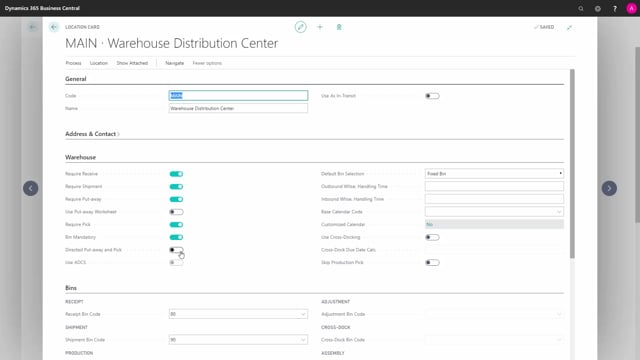


The location card in Business Central controls how the warehouse works for each location. By setting different checkmarks on the warehouse tabs, you decide whether to use bins, warehouse documents, or both. You can run different setups on different locations in the same company at the same time.
There are three overall levels. Basic means no checkmarks and no warehouse activities. Simple Handling covers any combination of receive, shipment, put-away, or bin mandatory without directed put-away and pick. Advanced means using directed put-away and pick, which forces all warehouse documents.
If you only set Require Receive and Require Shipment, you get a purchase receipt where you can combine purchase orders, but users cannot see prices because the receipt holds quantities only.
Setting Require Put-away and Bin Mandatory without Require Receive gives you an inventory put-away created directly from the purchase order.
The directed put-away and pick location and a manually configured location with all document checkmarks produce the same documents. The difference is that directed put-away and pick adds extra warehouse features on top.
How the location card controls warehouse setup in Business Central
In Business Central, the location card determines how the warehouse setup works. The checkmarks you place on the warehouse tabs decide whether you use bins, which warehouse documents apply, and how goods move in and out. This article walks through the options on the inbound side, from the most basic setup to the most advanced.
You can use different setups on different locations within the same company in the same database. That means one location can run completely without warehouse documents while another uses the full directed put-away and pick functionality.
Basic location with no warehouse activities
The simplest setup has no checkmarks at all on the location card. You create a purchase order, receive the goods, and put them on stock. There are no bins and no warehouse documents involved.
In Business Central this looks like a basic location with all the warehouse checkmarks left empty. This is what most people call the basic setup.
Require Receive and Require Shipment
The next step is a location where you check Require Receive and Require Shipment, but none of the other options. This is the kind of setup you might use for an external location.
On the inbound side you get a purchase receipt, and on the outbound side a sales shipment. On the purchase receipt you can combine several purchase orders to receive goods together. One thing to be aware of: the user cannot see prices on the receipt, because the receipt only contains quantities.
Inventory put-away with bins
You can also set up a location with all the main warehouse functionality but without a purchase receipt or a sales shipment. On the inbound side you get a put-away. Because there is no purchase receipt, this is called an inventory put-away.
For this setup you check Require Put-away and Bin Mandatory, but leave Require Receive unchecked. You then create an inventory put-away document directly from the purchase order, post on that document, and use the bins. The put-away happens directly through the inventory put-away made from the purchase order.
Bin Mandatory only
Another option is a location with only Bin Mandatory checked. Here you do not want to use any warehouse documents at all. Instead, you receive directly on the purchase order into the bin code on the purchase order line.
You still handle internal inventory movements and inventory actions, but these all rely on the simple bin handling functionality rather than separate warehouse documents.
Advanced setup with directed put-away and pick
The advanced setup uses all the warehouse documents in sequence. From the purchase order you create a purchase receipt. After posting the receipt, the system creates a put-away, and you put the goods into inventory through that put-away.
You can reach this advanced level in two different ways on the location card.
The first is a warehouse management location where you set the Directed Put-away and Pick checkmark. This automatically forces checkmarks in all the other warehouse documents, so every document has to be used. This functionality comes with a lot of extra features.
The second is a location where you manually check all the warehouse documents but leave Directed Put-away and Pick unchecked. From a document perspective the result is the same as the directed put-away and pick location. The difference is that you get less functionality, even though the documents you use are identical.
This gives you flexibility in how you handle warehouse management on each location card, and you can mix these approaches across the locations in your company.
Q&A
What does the location card control in Business Central?
The location card determines how the warehouse setup works. The checkmarks on the warehouse tabs decide whether you use bins, which warehouse documents apply, and how goods are received and shipped.
What is the most basic warehouse setup?
A location with no checkmarks at all. You receive goods directly on the purchase order and put them on stock with no bins and no warehouse documents.
Why can users not see prices on a purchase receipt?
Because the receipt only contains quantities. When you use Require Receive, the receipt document holds quantities rather than prices.
What is an inventory put-away?
It is a put-away created directly from the purchase order. You get it when you check Require Put-away and Bin Mandatory but leave Require Receive unchecked, so there is no purchase receipt.
What does Bin Mandatory on its own do?
It lets you receive directly on the purchase order into a bin code on the purchase order line, without using any warehouse documents. You handle inventory movements through simple bin handling.
What is the difference between directed put-away and pick and manually checking all documents?
From a document perspective the result is the same. Directed put-away and pick forces all warehouse document checkmarks automatically and adds extra warehouse features. Manually checking all documents without directed put-away gives the same documents but less functionality.
Can you use different warehouse setups in the same company?
Yes. In the same database and the same company, you can run different locations with different setups at the same time.