
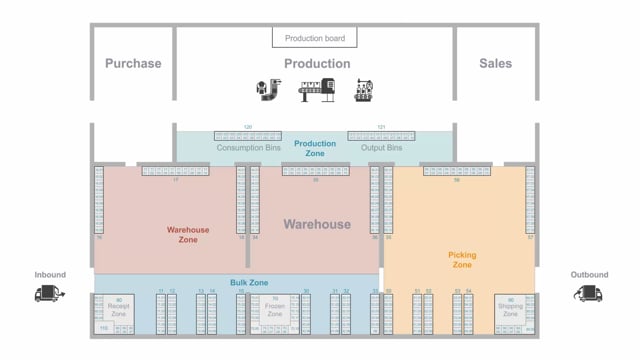


Warehouse zones in Business Central let you group bins by purpose so you can control where items are received, stored, picked, and shipped. You set them up on the location card by enabling the field Directed Put-away and Pick.
Use zones when you have a large or complex warehouse where the same item lives in multiple bins and needs default locations for picking, put-away, and refilling pick bins.
Typical zones include a receipt zone, a shipping zone, a picking zone, a bulk zone, a warehouse zone, a production zone, a cross-docking zone, and special zones such as a frozen zone. Business Central can refill your picking zone automatically using built-in algorithms, so high-running items stay available for fast picking.
Bins belong to zones, and the bins inherit settings from the zone they are part of. This makes it easier to control your complete inventory.
What warehouse zones do in Business Central
If you have a rather large warehouse, zones let you distinguish between where you want to pick items, store pick items, keep bulk items, handle frozen items, and so on. Using zones makes it easier to have one item placed in many bins and to define default places for picking, putting away, and refilling the pick bins.
So if you have a large and complex warehouse, the zone functionality comes in handy. You set it up on the location card by enabling the field Directed Put-away and Pick. Once that is active, you can define the zones you need for that location.
How to structure zones in a production plant
Take a production plant as an example. You can define several different zones for the location:
- Receipt zone – when you post a purchase receipt, the items go into the receipt zone. You can have one or several bins in this zone, and you know everything in there is still awaiting a put-away.
- Shipping zone – on the outbound side, this zone contains all the bins marked or set up as shipping bins.
- Picking zone – the zone you refill using the algorithms in Business Central, so all your high-running items stay available for picking.
- Bulk zone – for items you want to store away and then move into the picking zone as needed.
- Warehouse zone – a high-running zone for picking into the production area, containing raw materials and semi-finished products. You refill this zone from the bulk zone to pick faster.
- Production zone – this could be a single bin, but for a complex production you can add many consumption and output bins so you can pick into the zone.
- Cross-docking zone – for items you receive and want to transfer directly to the shipping zone. You skip put-aways and picks and add the items directly to the relevant orders.
- Frozen or other special zones – dedicated zones for items that need special treatment.
Refilling picking zones automatically
One of the practical advantages is that Business Central can refill your picking zone with built-in algorithms. That means your high-running items stay available where the pickers need them, without manual planning every time. You refill the warehouse zone from the bulk zone, and the picking zone from the bulk zone as well, so picking stays fast.
Fixing items to specific zones and bins
For special handling, such as frozen items, you can add functionality on both the item and the bins in a zone so the item is fixed to that zone and those bins. This keeps items that need particular conditions in the right place and prevents them from being stored anywhere else.
How bins relate to zones
On each zone you can add all kinds of bins. The bins are part of the setup coming from the zone, so they inherit the zone’s settings. This gives you tighter control over your complete inventory because the rules apply consistently across the bins in each zone.
Q&A
Where do you set up zones in Business Central?
You set up zones on the location card by enabling the field Directed Put-away and Pick. Once that is active, you can define the zones you need for that location.
When should you use warehouse zones?
Use zones when you have a large or complex warehouse where you need to distinguish between pick items, bulk items, frozen items, and similar. Zones make it easier to have one item in many bins and to define default places for picking, put-away, and refilling pick bins.
What is a cross-docking zone used for?
A cross-docking zone is for items you receive and want to transfer directly to the shipping zone. You skip put-aways and picks and add the items directly to the relevant orders.
Can Business Central refill picking zones automatically?
Yes. Business Central can refill your picking zone using built-in algorithms, so your high-running items stay available for picking.
How do you keep frozen or special items in a dedicated zone?
You add functionality on both the item and the bins in the zone so the item is fixed to that zone and those bins. This keeps special items in the right place and prevents them from being stored elsewhere.