
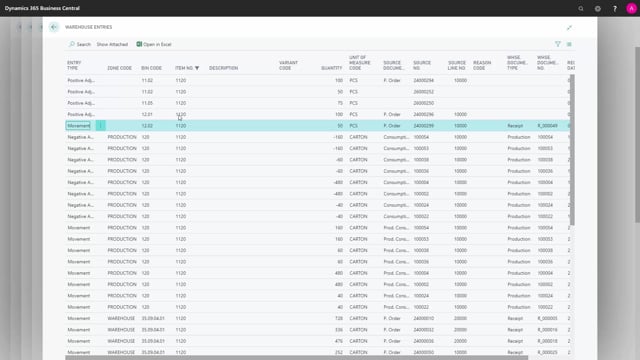


If you run a warehouse location in Business Central with warehouse receipt, warehouse put-away and bin enabled, but without the directed put-away and pick checkmark, the system stores warehouse entries in the base unit of measure. This means that even if you purchase items in a different unit of measure, such as a box of 25 pieces, the warehouse entries are split down to individual pieces.
If you want your warehouse entries to keep the purchase unit of measure, you need to enable the directed put-away and pick checkmark on the location card. Without it, the warehouse split is unavoidable.
The item ledger entries still show the received quantity correctly. In the example, receiving 2 units of a unit of measure that equals 25 pieces each results in 50 pieces, both on the item ledger entry and on the warehouse entry.
The warehouse setup used in this example
This walkthrough uses a Business Central location with the following checkmarks enabled on the location card:
- Warehouse receipt
- Warehouse put-away
- Bin
The directed put-away and pick checkmark is deliberately left off so you can see the difference it makes to how warehouse entries are stored.
The purchase and receipt flow step by step
The example starts with a purchase order containing two items. One of the lines has a quantity of 2, and that line is not in pieces. It uses a different unit of measure code entered on the item card. This detail matters for what happens later in the warehouse entries.
The flow works like this:
- Release the purchase order.
- Create a warehouse receipt, which opens automatically.
- The warehouse receipt shows the two lines with quantity 2 and 10 and their unit of measure codes.
- Fill in the quantity you want to receive.
- Post the warehouse receipt.
Posting the warehouse receipt does two things. It posts item ledger entries, and it posts warehouse entries into your default receipt bin. After posting, the quantity received shows 2 and 10.
Handling the put-away document
Posting the receipt also creates a warehouse put-away related to the document. When you open the put-away, you see four lines: quantity 2 and quantity 10, each with a take line and a place line.
You use this document to put the goods away into stock. Enter the quantity to handle, and change the bin code if you want to place the items in a different bin than the one suggested. In practice, you find the right bin codes while walking around the inventory and then update them in the put-away document.
When you register the put-away document, the system creates warehouse entries that move the items from your receipt bin to your warehouse bin.
Why warehouse entries are stored in base unit of measure
To understand the effect, open the item card for the line that uses a different unit of measure code and navigate into the item ledger entries.
On the main location, you can see a received quantity of 50, which equals the 2 units you received. The warehouse entries tied to the purchase order line also show 50 pieces. The system inserts the warehouse entry in base unit of measure, not in the purchase unit of measure.
This happens because the directed put-away and pick checkmark is not set. Without it, warehouse entries are always split into the base unit of measure. You can also see the movement entry going from the inbound bin to the inventory bin.
What to do if you need unit of measure in warehouse entries
If you want to keep unit of measures in your warehouse entries instead of having everything broken down to base units, you need to enable the directed put-away and pick checkmark on the location card. That is the deciding setting. Without it, the warehouse will always store entries in base unit of measure regardless of how you purchase the items.
Q&A
Why are my warehouse entries shown in pieces instead of the purchase unit of measure?
Because the location does not have the directed put-away and pick checkmark enabled. Without it, Business Central splits all warehouse entries into the base unit of measure. Purchasing 2 boxes that each equal 25 pieces results in a warehouse entry of 50 pieces.
How do I keep the unit of measure in my warehouse entries?
Enable the directed put-away and pick checkmark on the location card. This is the only setting that lets warehouse entries retain a unit of measure rather than being broken down to base units.
Does the missing directed put-away and pick checkmark affect my item ledger entries?
No. The item ledger entries show the correct received quantity. In the example, receiving 2 units that equal 25 pieces each correctly results in 50 pieces on both the item ledger entry and the warehouse entry.
What does the warehouse receipt posting create?
Posting the warehouse receipt creates item ledger entries and warehouse entries in your default receipt bin. It also generates a warehouse put-away document linked to the purchase order.
Can I change the bin code during put-away?
Yes. In the put-away document you can change the suggested bin code to a different bin where you actually place the goods, then register the document to move the items from the receipt bin to the warehouse bin.