
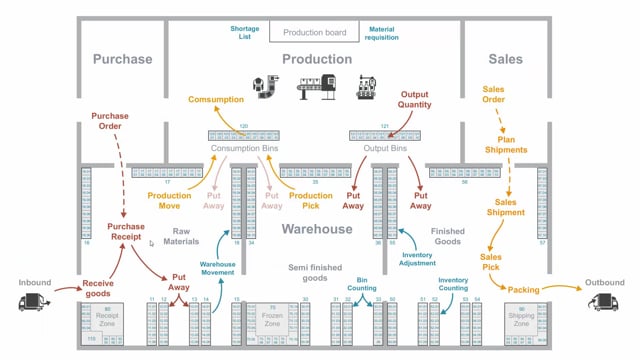


When you set up bin numbers in your ERP system, the way you structure them determines how quickly your warehouse staff can find a location. The key principle: a bin number should be readable on its own, so anyone can locate it from the number alone without needing a map or extra instructions.
Build your bin codes in a logical order that follows the physical layout of the warehouse. Use a hierarchy that goes from rack to frame to shelf to place, and add more levels only where the physical storage actually requires it. Make sure the codes sort alphanumerically so the system lists them in the same order you walk the aisles.
Why bin numbers should match the physical warehouse
Bin numbers exist to make locations findable. When you create your bins in the ERP system and mark them physically in the warehouse, keep the two in sync and use a structure that reflects how the warehouse is actually built. The goal is simple: a warehouse worker should be able to find a bin using only its number.
A typical warehouse has a series of racks numbered 10, 11, 12, and so on, plus dedicated shipping bins and receiving bins. The numbering you choose for the bins inside each rack should mirror the physical shelves and positions, so the number tells the worker exactly where to go.
Simple bin codes for floor storage
If a rack holds goods directly on the floor, for example pallets, you can keep the bin codes simple. For rack 32, you would number the floor positions 32.01, 32.02, 32.03, and so on. When you only have floor bins, this flat numbering is enough and works well.
Adding dimensions for racks with shelves
Most racks are not just floor storage. They have several frames, and each frame has multiple shelves. In that case, add more dimensions to the bin code so it captures the full position.
Take rack 32 again. Say it has six frames. Frame number 3 has four levels: the floor plus three shelves above it, numbered 1, 2, 3, and 4. The frame number is one dimension, and the shelf number is another. Each level you add to the physical storage should get its own number in the bin code.
Subdividing wide shelves into places
Sometimes a single shelf is wide enough to hold several distinct items side by side, even when there are no physical dividers between them. When that happens, break the shelf down further into numbered places.
For example, rack number 32, frame number 3, shelf number 2 might be divided into place number 1, 2, and 3. This gives you a more detailed bin code that points to the exact spot on the shelf, not just the shelf in general.
The same logic applies to drawers. If a shelf contains a drawer, you can add another number to the bin code to identify it.
Keep the structure logical and sortable
Whatever level of detail you use, two rules hold throughout. The bin codes must sort alphanumerically, so the system presents them in a sensible sequence. And the structure must be logical from rack to frame to shelf to place, so everyone in the warehouse can find the bin they are looking for quickly.
Q&A
How should I structure bin numbers in my ERP system?
Use a logical hierarchy that mirrors the physical warehouse, going from rack to frame to shelf to place. Add more levels only where the storage actually has them. Make sure the codes sort alphanumerically so the system lists bins in the same order you walk the warehouse.
What is a simple way to number floor bins?
If a rack holds goods only on the floor, number the positions sequentially, for example 32.01, 32.02, 32.03, and so on. This flat numbering is enough when there are no shelves to account for.
How do I number bins in a rack with multiple shelves?
Add a dimension for each physical level. Identify the frame, then the shelf within that frame. For example, a rack with six frames where frame 3 has a floor plus three shelves numbered 1, 2, 3, and 4. The frame and the shelf are separate dimensions in the bin code.
Should I divide a wide shelf into separate bins?
Yes. If a shelf is wide enough to hold several distinct items side by side, even without physical dividers, break it into numbered places. For example, rack 32, frame 3, shelf 2, place 1, 2, and 3. This points to the exact spot rather than the whole shelf.
Why does the order of bin numbers matter?
Bin numbers exist so warehouse staff can find a location using only the number. A logical, sortable structure means anyone can locate a bin quickly without needing extra instructions.